Friday, February 26, 2016

EDDIE THE EAGLE

Reviewed by Patrick Gibbs


Out of Four


Starring Taron Edgerton, Hugh Jackman, Jo Hartley, Mark Benton, Tim McInnery
and Christopher Walken
Screenplay by Sean McCaulay
and Simon Kelton
Directed by Dexter Fletcher
Rated PG=13 (some suggestive material, partial nudity and smoking) 

I have never been known as a sports enthusiast, but there has always been something about the Winter Olympics that has held a sense of excitement and joy to me (except for when they were in my home state, oddly enough.). I had a few Olympic heroes as a kid: Scott Hamilton, Jane Torvill and Christopher Dean, Katarina Witt, Brian Boitano . . . and Eddie Edwards.

In addition to being the only one of this group that was not a figure skater, Eddie was also the only one who never medaled. But that isn't isn't why you loved Eddie. You loved Eddie because not only did he get to go to the Olympics, but he took you with him.

Taron Edgerton (Kingsman: The Secret Service) stars as Eddie, an awkward loner growing up in England, obsessed with a dream: to be an Olympic athlete. Despite the fact that he takes to any sport he tries like a duck to rednecks, the boy simply refuses to stop trying. His mother (Jo Hartley) is mildly  terrified that her clumsy son is going to get himself killed, but cannot bring herself to crush his dream. His father, on the hand, seems fully aware that he is not only the Dad character in a movie, but a quirky, stern, British one at that, and therefore must follow the handbook and believe that Eddie needs to get his head out of the clouds and learn the family trade.

When Eddie takes to the idea of skiing, he falls short of making the Olympic team, in no small part because the team doesn't want him. Every time the young man comes close to reaching his goal, the officials change the rules make it harder to get on the team. But when Eddie gets the idea of becoming the first British skijumper, he may have found his way in due to lack of competition.

Enter Bronson Peary (Hugh Jackman), a swaggering, alcoholic American mechanic who works on the grounds where Eddie is training. But Peary is more than just a handyman: he's was once a great skijumper until he lost, took to drink, and retired in disgrace, much to the dismay of his mentor (Christopher Walken.).

It goes without saying that the cynical Peary reluctant starts to admire Eddie's tenacity and eventually is won over to becoming his trainer, and that as Eddie strives to conquer the slopes, it eventually inspires Peary to conquer the bottle. This is an extremely formulaic feel good sports movie,rand much like its title character, this movie isn't about being unpredictable It's about being fun and inspiring. It's about pleases the crowd, and that it does, with the same gusto as its namesake. Between the sincerity of the lead performances, the wit of the script, and the thrilling, creatively shot jumping sequences (this is the only time I have ever actually liked the use of GoPro cameras in a feature film), the movie delivers on every level as a work of entertainment. It's pure joy from beginning to end.

It's also heavily fictionalized. Jackman's character is completely made up for the purposes of the film (he's not even an amalgam of several real life people, he's just flat out imaginary) and much of Eddie's training and formative process is, too say the least, simplified. But when it's all said and done, this isn't a major chapter in world history, it's the story of how a legend was born, and much like The Revenant (a very, very different film to say the least ) it's almost essential in capturing the spirit of this story to embellish it. Some may feel otherwise and go harder on the film for it's fast and loose approach, but I simply had too much fun, was far too moved, and too overcome with nostalgia to hold any of this against the movie.

Edgerton is completely unrecognizable, and just as capable of carrying a film with thick glasses and at least forty extra pounds of tubbiness as he was as the smooth, stylin' bad boy in Kingsman. Jackman, one of Hollywood's most charming actors with one of it's very worst track records for appearing in good films, is as good in this as he in an actual good X-Men movie.The two could not play better off of each other, and when you add to that Christopher Walken and Tim McInnery, you've got the most entertaining cast of the year so far by a number of yards.

Eddie may not be a true champion, but it is spirited fun that left me feeling glad to be alive.

Friday, February 5, 2016

HAIL, CAESAR!

Reviewed by Paul and Patrick Gibbs


Out of Four


Hail, Caeser!
Starring Josh Brolin, George Clooney, Alden Ehrenreich, Ralph Fiennes,  Jonah Hill, Scarlett Johanson, Frances McDormand, Tilda Swinton, Channing Tatum
Written and Directed by Joel & Ethan Coen
Rated PG-13 (vulgarity, adult themes)


As brothers/filmmakers with a somewhat odd and subversive sense of humor, Joel and Ethan Coen are superheroes to us. But it's never easy to review a Coen brothers film. Like many auteurs, their creative vision is so unique that it has become almost a subgenre unto itself. But unlike, say, Quentin Tarantino, whose nihilistic violence and pop culture worship creates a familiar tone to all of his film, the Coens have a broad range that makes it difficult to nail down what exactly is the feel of a Coen film. They have their own voice, but they use it to sing far more than one note. Nevertheless, that note is so distinctively Coen that, while their sensibilities suit us very well, the most common appraisal we give of a Coen film to others is "If you're not a Coen fan you'll probably have a hard time getting into it."

While their latest film, Hail, Caesar!  fits more into the category of comedies like O Brother, Where Art Thou? than to grittier and more dramatic fare like Fargo or No Country For Old Men, it's not quite in the same category. Hail, Ceasar! is funny, but it doesn't get the kind of constant laughs that O, Brother or The Big Lebowski did, and it doesn't really seem to be trying to. Above all else, it seems intended to create a portrait of golden age Hollywood both on and off screen, one that at once captures the magic of the movies and the sordid drama behind the scenes, and is simultaneously cynical and loving about both.


Josh Brolin, a member of the Coen Repertory Company since No Country For Old Men, plays the lead role of Eddie Mannix, a "fixer" for fictional Capitol Pictures in post World War II Hollywood. Eddie is responsible for dealing with the vast array of daily crises which plague production, including:

- Director Laurence Lorentz' (Ralph Fiennes)  fury at being forced to turn cowboy star Hobie Doyle (Alden Ehrenreich) into a suave and sophisticated leading man in the drawing room comedy Merrily We Dance.

- Beloved Hollywood sweetheart DeAnna Moran (Scarlett Johansson) needing a husband to avoid the bad publicity of having an out of wedlock child.

- Being hounded by sister gossip columnists Thora and Thessaly Thacker (both played by Tilda Swinton) about a reported scandal involving superstar Baird Whitlock's first film.

-Whitlock himself (George Clooney) being kidnapped off the set of the studio's prestige biblical epic, Hail, Casear - A Tale of the Christ.

Meanwhile, at the same time that Eddie is dealing with all of this, he's being courted for a cushy, well-paying job at Lockheed. Will he leave Hollywood behind?

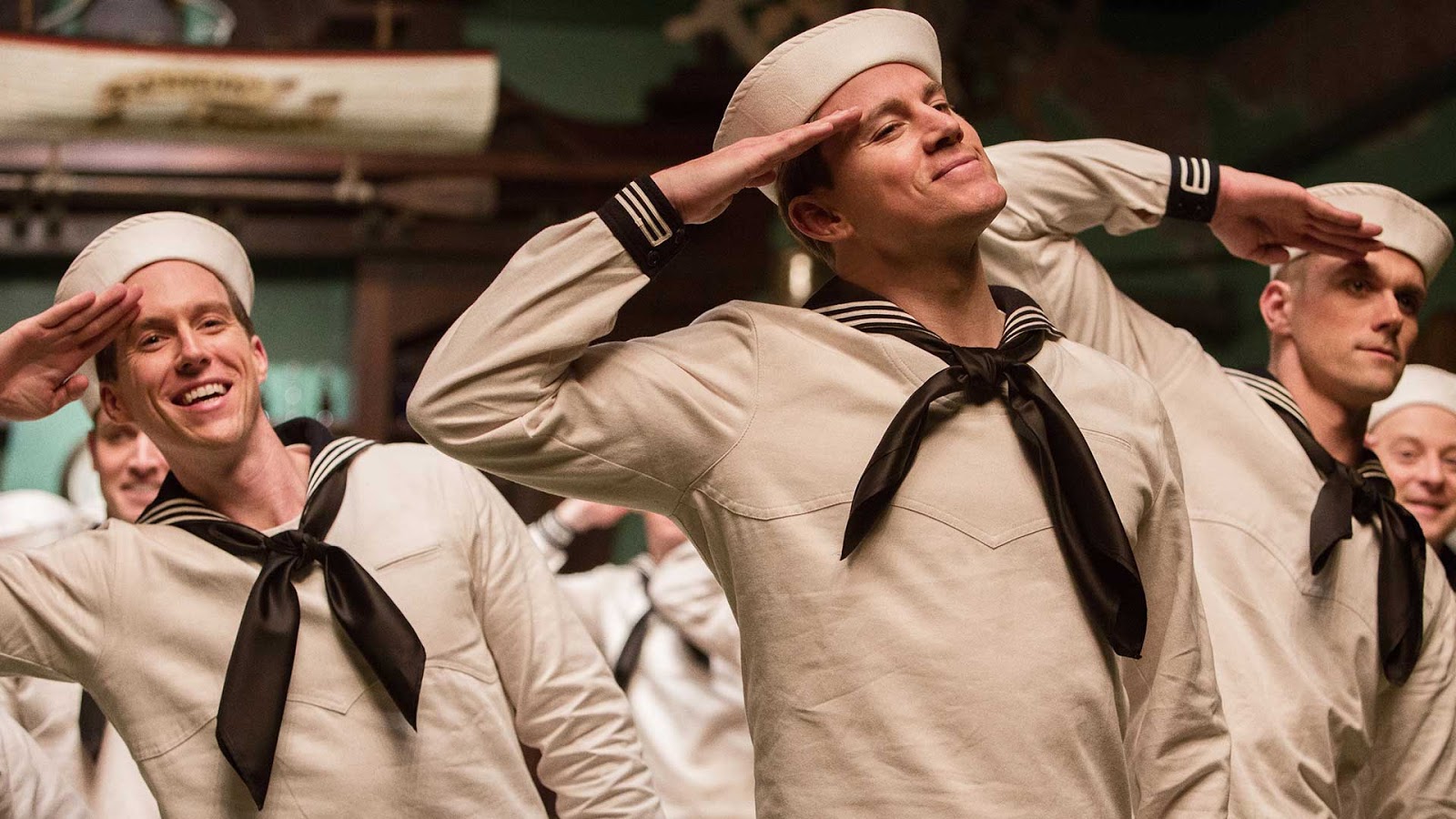
A film with this many diverging plot elements could easily feel disjointed and suffer for varying quality from Story A to Story B, but the Coens and their stellar cast keep things moving and ensure that each subplot is engaging (even if the only one of the characters besides Mannix who seems like a decent guy is Hobie). Every one of the major stars blends perfectly into both the time period and the surreal style of a Coen comedy, and the film within a film sequences are real highlights, giving the Coens and genius cinematographer Roger Deakins a chance to flawless recreate the look of everything from Ben-Hur to a Roy Rogers cowboy musical. Clooney and Tatum are outstanding, with Tatum hitting his song and dance number (A Gene Kelly-esque tap dance to a song called "No Dames") out of the park, and Clooney giving us both the self-centered buffoon we expect from him in a Coen film, and a pitch perfect recreation of the heightened "epic" acting style of a Charlton Heston or Richard Burton. One of the real strengths of the film is that the movie sequences tow the line between homage and parody so perfectly. There's just enough comic exaggeration there to make it funny, but they're getting all of these styles and genres right and showing them a surprising level of respect. Clooney's final monologue at the foot of the cross is both cheesy and strangely moving until it reaches its comic climax, and Tatum doesn't just fake the dancing well enough, he dazzles and shows that he could have been a major star of light musical comedies back in the day.

If the film disappoints in any way, it's the aforementioned failure to provide the laugh a minute ratio we expect. But it's consistently engaging and entertaining, and some sequences are hilarious, such as Lorentz struggling to feed Hobie a line reading or Eddie meeting with an interfaith council to ensure the Hail, Caesar script is sufficiently respectful to all beliefs (Robert Picardo steals the film in his cameo as a cantankerous Rabbi). And the strange mix of weariness and reverence both Eddie and the film itself show for the craziness of Hollywood is surprisingly thoughtful, making the film something of an rumination on whether Hollywood or the movies really matter, and what they mean to us. Brolin is a very important part of making the film work, and he gives yet another strong performance which shows that the oldest Goonie has grown up to become an excellent actor with an impressive range. He carries the film effortlessly.

In then end, Hail, Caesar! doesn't rank with the Coen's best films, and it may turn out to be just too bizarre for some  (a line probably written in reviews of every Coen movie) . But it's a more than solid entry in their filmography, and for fans of both the Coen Brothers and old Hollywood, it's a must-see

Saturday, January 23, 2016

THE 5TH WAVE


Reviewed by Patrick Gibbs         


Starring Chloe Grace Moretz, Nick Robinson, Live Schreiber, Alex Roe, Ron Livingston, Maika Monroe and Maria Bello
Based on the novel by Rick Yancey
Screenplay by Susanna Grant, Akiva Goldsman and Jeff Pinkner
Directed by J Blakeson


Leonardo DaVinci foresaw manned flight. Orson Scott Card foresaw the internet. But there are some things about the future that no one can predict, no matter how much foresight they possess, and the post apocalyptic teeny bopper genre is most certainly one of those things.

For all of its many detractors (and I count myself as one) the success of the Twilight saga showed the entertainment world that there was an audience desperately crying out for stories centered around young female protagonists, and as such, it has actually had a very positive effect. The Hunger Games franchise was so far above the aforementioned title in terms of a compelling story and characters that it crossed over into appealing to many adults, and it has changed the popular notion of what a story for girls is supposed to be. You may be tired of these kinds of movies. The latest installment of the Detergent series may not interest you, but there is a large group that not only wants this, but needs to be represented. So, as badly done, backward and backhandedly sexist as Twilight most certainly was, I still applaud what it has done for a generation.

Unfortunately, as is always the case, the message that creators of popular fiction have taken from this is just as much that churning out variations on the same old thing tailored to fit the current trend means an easy return on your investment as that girls are people, too. Whether it's callous but stylish wise-cracking hitmen or teenage girls facing down the end of the world, it's always easier to just copy than it is to create. The 5th Wave is he latest movie trying to cash in, and to say that it is nothing more than War of the Worlds in a training bra is frankly being too kind.

Cassie (Chloe Grace Moretz) is a regular teenage girl with regular dreams, which she dutifully jots down in a diary, according to the Hollywood teenage girl handbook. She is also a cheerleader, and she has a crush on a football player.  But her entire world (not to mention everyone else's) is drastically changed by the arrival of  "The Others," which is the name that mankind gives to the inhabitants of mysterious spacecraft that appear around the world, hovering over cities and suburban neighborhoods, but not attempting to make contact, making everyone over 20 in the audience suddenly want to watch Independence Day. But of course, when "The Others" do make contact, they do it in the form of wanton mayhem and destruction in an attempt to exterminate the human race, because they too have a Hollywood handbook to follow.

Cassie and her father and brother Sammy end up in a military facility for survivors  (I honestly can't remember what happened to Mom, or if she eve existed, it was so hard to care.). It is there that they are informed that these invaders can take human form, and may be amongst them now ("Wait! You're saying that some of us are others?" a featured extra spouts, in what is likely to be the most unintentionally amusing line of the year.).

When news arrives that the base is under attack, the children are loaded onto buses to be taken to safety first. But Sammy forgets his Teddy Bear, so his dutiful older sister must go retrieve it. But of course, the buses leave without her, so when the adults are all gone, she must make it on her own.

From here, we follow dual storylines as Cassie tries to make it to her brother, meeting a mysterious yet ruggedly handsome young stranger (surprise) along the way, and her brother ends up training to be a soldier alongside her secret crush the football player (played by Jurassic World's Nick Robinson). The two plotlines compete to see which one can be more predictable and insipid, but Cassie's plot wins out in the end, which is an impressive accomplishment considering the Blackhawk Down Goes To Middle School sequence. I find it both fascinating and indescribably disturbing that so much of our popular fiction is based on the premise of kids being handed a gun and made into soldiers, forced to grow up immediately as they face kill or be killed situations, and yet no one bothers to see Beasts of No Nation, the most shameful Oscar snub of 2015. Is anyone else bothered by the fact that children being forced to kill is endlessly interesting to us as a fictional "what if?" science fiction scenario as long as they are white and American, but if they are not, and it's happening right now, nobody cares??? If I'm really the only one, then to quote Lucy Van Pelt, "Stop the world, I want to get off."

But back to the topic at hand: this particular movie is boring, poorly paced, and woefully predictable. The largely capable cast does their best with the material, but the immensely talented Moretz, who has given truly great performances in films ranging from Hugo to Kick Ass to The Equalizer that the fact that she could and should be doing better seems evident even to her, and her performance seems half hearted.  Robinson fares much better, and provides the only moments of the film where I started to care about any of these characters as if they were people. As usual, Liev Schreiber is wasted in a thankless role, and Mario Bello seems to be going for "first Razzie candidate of the year" in a small role as a Southern Fried Military woman.

In the end, this isn't quite bad enough to be interesting as a failure, but it's nowhere near good enough for any complimentary word higher than "watchable." If it reaches an audience, it will only be further testament to how badly the long underrepresented female young adult audience wants movies aimed at them, and to our responsibility to make better ones so that they we make sure that they are truly being represented and not just exploited with this new pop culture trend.

Friday, January 8, 2016

THE REVENANT


Reviewed by Patrick Gibbs


Leonardo DiCaprio, Tom Hardy, Domhnall Gleeson, Will Poulter
Screenplay by Mark L. Smith and Alejandro G. Innaritu
Directed by
Alejandro G. Innaritu

Rated R (Violence, gory images, a sexual assault, and profanity)

Oscar Winner Alejandro G. Innaratu's 19th century story of survival has received a lot of press and a lot of hype, including an extremely bizarre controversy that spread over the Internet, when it was falsely reported that Leonardo Dicaprio's character is raped by a bear on screen (the studio quickly issued a statement to clarify this ridiculous assertion.). It may be the second most talked about film of the holiday movie season, surpassed only by Star Wars: The Force Awakens.  So, with all of this talk, the big questions are simple: is is really as violent as you've heard? And is it good enough to justify that violence?

The answers are: "yes and no," and "almost." It's every bit as brutal and shocking as all that, but it's not the callous, bloodthirsty, devoid of any moral compass, Tarantino style revenge story that you might be expecting. What is being unflinchingly portrayed here  is the brutality of the conflict between white frontiersmen exploring and sometimes pillaging what is, to them, a new land, and the Native Americans who call it home. Even more so, it's a harsh portrayal of man's desperate determination in surviving against the elements of nature. The often very graphic depictions are essential to the story, and most of it doesn't feel as gratuitous as it easily could have, but the question "Did I really need to see that happening?" is going to vary wildly from viewer to viewer.

Hugh Glass (DiCaprio) is a frontiersman and trapper guiding a quasi-military group of hunters and fur trappers through the Louisiana purchase territory in 1823.  His half Pawnee son, Hawk (Forrest Goodluck) is with him on the journey, and Glass keeps him close, especially after the group is ambushed by Arikara indians, leaving half of the party dead. Captain Henry (Gleeson) the leader, knows he they are being pursued, and that tensions among the men are high. Things are further complicated when Glass is viciously attacked by a bear trying to protect her cubs and is nearly mauled to death.

Glass is cared for as best as Henry can facilitate, but dragging a nearly dead man through the mountains and snow is significantly slowing down the party, who need to get back to the safety of the Fort before the Arikara find them. One of the men, Fitzgerald (Hardy) pleads a case for putting Glass out of his misery for his sake and theirs, but the Captain can't bring himself to do it. He offers a sizable cash reward anyone who will stay with Glass and care for him until he passes, and perform a proper burial when the time comes. When Hawk and another young man, Bridger (Will Coulter) offer to forfeit their shares to whoever will stay with them, Fitzgerald surprisingly volunteers on the grounds that he needs to make up for his losses on the expedition.

Of course, things only get worse from there, and a series of events leads up to Glass being left alone to die, as by all standards of sense he should. But Glass simply refuses to give up.

The story of Hugh Glass has been told and retold for over a century, and the dramatic embellishments added over the years are considered by historians to trace back to Glass himself. So on the one hand, once you read up on this and discover that most real life accounts are not as horrific and violent as the film portrays, that Glass's son Hawk is a creature of fiction, and that the final confrontation with Fitzgerald (whose real name was William Fitzpatrick) ended very differently, you start to question just how much of the unflinching brutality should be praised and how much of it should be criticized. But 20 years after Braveheart cleaned up at the Oscars, this is hardly anything new to Hollywood. This is an extremely compelling and vivid retelling of the Glass story, and history and legend are both timeless and timely, being told through the mouth of the storytellers of the day.

Innaritu is a remarkable storyteller, and his seeming control of every detail his camera captures is really unsurpassed by anyone. The "how did they do that?" factor to this movie is nothing short of staggering.  But if you're hoping to find a redemptive, inspiring element, it's not to be found. Instead, Innaritu juxtaposes the idea of what we will do to stay alive vs. what, if anything, we are ultimately living for, and the sad reality that finding the answer to the latter question can be more brutal than the fight to survive. As we see Glass's dead son live in flashbacks and dreams, as well as his interactions with and fierce protection of young Hawk, we discover that Glass and the bear are kindred spirits, and that realization is more than a bit haunting.

The movie does tend to meander a bit at times, and runs a bit too long. It's important not to rush Glass's self-recovery and perilous journey, but there are moments when it does start to drag a bit. In a particular, an extended sequence when he is happened upon by a lone Pawnee who helps nurse him back to health started to make me feel like I was watching an attempted reboot of The Lone Ranger, and probably could have been cut entirely.

But it's hard to fault a movie too much for aiming so high, and this is as skilled a piece of filmmaking as any in 2015, or in recent memory. The cast delivers all around, though there seems to be a deliberate (and wise) choice not to truly let us into anyone's head. Each character is an enigma, and we are never entirely sure what is going inside, or who they were before they ended up on this hellish predicament.

DiCaprio, the perennial Oscar hopeful, is obviously the one getting all of the attention (and he should be getting some for his pained, brooding performance that actually becomes more human and low key the further Glass has to descend into an animalistic world), but the most compelling characterizations actually come from Hardy, Gleeson and especially young Poulter, whose combination of wide eyed fear, staunch bravery, and ultimately self loathing and sorrow at his own weakness, make his wonderfully human portrayal of the legendary frontiersman Jim Bridger arguably the best part of the film. Hardy is everything we've come to expect him to be: burly, stoic and imposing, with a hard edge that masks the vulnerability inside, and as unlikable as Fitzgerald is, you can't completely dismiss his point of view. Gleeson has a rare ability to fit perfectly into any film, and adds an extremely welcome presence. Emmanuel Lubezki's captivating cinematography is arguably outstanding, and will likely guide him to his third Oscar in a row (and in the process put something of a damper on the current movement toward going back to shooting on film, as his stunning work here on digital catches bold and atmospheric images that burn into the mind's eye.).

On the whole, the movie is a triumph, if not for all tastes.  Innaritu tends to make "mood movies" that will either really work for you or really not, depending on how you go into them, and this is hardly the exception to that. But if you're up for it, there is a lot to admire here.


Thursday, December 31, 2015

PATRICK'S 10 WORST LIST

by Patrick Gibbs

2015 was a big year in cinema. It was the year when super heroes started to fade at the box office, as audiences clamored for something they had never seen before, like Jurassic World, Mission: Impossible 5, and the seventh Star Wars and Rocky movies. It was the year that Pixar proved it was not slipping into mediocrity by giving us one of their best films ever, only to immediately follow it with one that put the "ocre" into media in a way Disney usually reserves for daytime cable. It was the year The Hunger Games finally reached its epic conclusion, which was so epic in scale that it could only be described using one word: epic. It was the year that Leonardo DiCaprio finally, at long last, either did or didn't win an Oscar, and it was the year when Melanie Griffith and Don Johnson's daughter (I was frankly quite disappointed that she did not have bright orange clown hair and 5'0 clock shadow) became a star in 50 Shades of Grey But Only One Facial Expression.

But it was also, as is often the case, a year when many truly terrible movies disgraced the silver screen. Here are my choices for the Ten Worst Films of 2015.


1. MORTDECAI

Johnny Depp, who has been striving so hard to become the most reliable name in crap, screwed up big time by giving a terrific and exhilarating performance in Black Mass this fall, but fortunately, he can rest easy knowing that people have already forgotten his exceptional work there. But have they forgotten Mortdecai?

 Mortdecai is a juvenile and surprisingly dull affair that is trying hard to be Ian Fleming meets P.G. Wodehouse, with a dash of the biting irreverence of Blackadder. It succeeds in channeling all but three of those sources, and at best we are given flat one liners such as Depp examining a photo of an old lady with an arrow sticking out of her back and quipping "This woman is badly in need of a chiropractor," or a never ending series of jokes about how everyone hates the title character's mustache, which he happens to love (this bit is stolen directly from Jeeves and Wooster, and it goes without saying it was much more amusing in the original.); At worst, we get assaulted by a windup 6th Grade joke machine that appears to have been set for a repeating pattern of "fart, vomit, balls." The presence of an appealing cast and the promise of a throwback to better days of cinematic slapstick make it very hard not to want to give this thing a chance, but the movie manages to fail on every possible level.


2. OUTCAST
Hayden Christensen and Nicolas Cage star. . . wait, there's actually more . . . as disgraced British Knights of the Crusade, who have ended up in 12th Century China. Both actors seem to be trying to evoke Tom Cruise in The Last Samurai,  but Christensen plays more like Kevin Costner in Robin Hood: Prince of Thieves, minus the charisma, and Cage decides to throw in traces of Jack Sparrow, Travis Bickle and every last character from Robert Altman's musical version of Popeye for good measure.

In fairness to the actors, it must be stated that one of the bigger strengths of the film is Christensen's ability to handle a sword (and the fact that he usually does not talk when he is doing so), and the top knot in Cage's hair after he tries to assimilate into life in China is probably as good an explanation as we're ever going to get as to why his face is pulled so uncomfortably tight nowadays. The former Academy Award winner doesn't so much chew the scenery as swallow it whole, laughing like a sweaty toothed madman as he growls out such memorable lines as "the Black Guahds ah heh as thick as flies on a fahting goats oss thanks to you!"

The basic set up is simple: the corrupt son of the King is enraged to learn that his little brother has been chosen to succeed their father instead of him, so, having seen Gladiator, he kills the king, framing his brother, who must flee for his life along with his older sister. Along the way they meet the once great warrior What's His Name (Christensen) passed out in an opium den, and they are impressed when he beats up a group of beer swilling truckers who break the jukebox and insult his favorite hockey team or something like that (almost none of that last statement is accurate, but in fairness to me, it's hard to care what's going on when you aren't paying attention.). The point is, he can fight, so they latch on to him, and the discarded and cynical former Knight soon realizes that even though he thought he didn't believe in anything anymore, it turns out that Asian girls are still hot.

Former stuntman Nick Powell directs the first 40 minutes as if he wants to be Edward Zwick, and then out of nowhere it appears as if he suddenly has to go to the bathroom and hands control over to a ridiculously enthusiastic, if not very skillful, Paul Greengrass fan, who has never learned the term "director's line." The shift in style could not be more abrupt, but after about 10 to 15 minures Powell takes the reigns again and we go back to the original style just in time for Cage and Christensen to settle their differences and fight for the glory of whatever it is they believe in, and one of them dies doing whatever it is he loved. I forget which one.

3. THE BOY NEXT DOOR

Jennifer Lopez stars in this laughable "thriller" from bad movie icon Rob Cohen. Lopez is Claire Peterson, a High School English teacher whose husband (John Corbett) cheated on her, and they are currently separated while she decides whether to forgive him, and their shy, awkward teenage son Kevin just wants things to go back to the way they were. Enter Noah (Ryan Guzman), the nice young man who has moved in with his grandmother next door after his parents died.  Noah befriends young Kevin and ends up hanging around the house a lot. The misplaced Kevin is thrilled to have a cool new friend in his life, and Claire finds herself charmed by the boy's polite manner, the way he looks out for her boy, his surprising interest in English lit and the way he likes to strip naked while standing next to the window. So naturally, when Dad and Kevin go on a camping trip, Noah just happens to show up, and Claire invites the boy in for dinner and perhaps a cup of adultery.

Claire regrets her impulsive indiscretion, especially when Noah turns out to be a new student in her class. Claire is, of course, horrified to discover that she gave a student several F's in one night, if you get my drift, but Noah is after more than just his teacher's celebrated A. He tells her he is in love with her, and that he is going to make her happy the way she deserves to be. But when he sees her out on a date with her husband, Noah registers his disapproval by tampering with the old man's brakes, nearly getting both father and son killed. As Noah becomes progressively more unstable, the film becomes more and more ludicrous until we learn that Noah killed his own father, and everything leads to an action packed showdown as Noah tries to burn the family alive and Claire stabs him in the eye with her son's epipen (another in your face adrenaline rush from the director of the original Fast and the Furious.).

This is about as forgettable a variation on Fatal Attraction as Hollywood has ever spewed out, and it is strictly for non discriminating J-Lo fans (as if there were any other kind.).

 4. KNOCK KNOCK

And speaking of taking an interest in the younger generation,  let's take a look at the latest from director Eli Roth. Keanu Reeves plays Evan Webber, a family man and architect who is in love with his wife, his kids and his life. But his wife is a workaholic artist, and as a result, Evan hasn't had his brush cleaned in a little while, if you get my drift. So when she and the kids go on a beach trip and Evan stays home due to a minor shoulder injury that comes and goes depending on whether it suits the purposes of a story that seems to be made up as we go along, he gets visited by some univited guests.

Genesis (Lorenza Izzo) and Bel (Ana de Armas), two free spirited and gorgeous young girls, show up on his doorstep during a tumultuous rainstorm, on their way to a party and hopelessly lost. The gentlemanly Evan invites them in out of the warmness of his heart, but the longer they stay, the more the pulsing warmth in his heart tends to take the express elevator down a few floors, if you get my drift. By the time their clothes are in the dryer and they sit around in robes talking about sex, Evan is getting really anxious for the Uber driver he called to pick up the girls to get there. But by the time he does, the two girls have surprised our well meaning protagonist in his shower, and well, you can fill in the blanks from there (Evan certainly does, if you get my drift.).

He wakes up the next morning, horrified at what he has done, and tries to hurry them out the door so he can put this mistake behind him. He ends up driving them some distance away, believing he is rid of his little problem. But surprise surprise, they show up again, hitting him over the head and tying him up, torturing him, frolicking and breaking things, trying on every single outfit in the house (psychopath Barbie just loves to accessorize!) and generally doing their best to let you know that Roth must be a great director because it looks like he has probably seen A Clockwork Orange like, a bunch of times. The crazed and clearly dangerous girls reveal themselves to be under age, and they are out to punish and destroy our "hero," whom they have been spying on for some time. As we lead up to his planned execution at dawn,  the 108 pound gal pals effortlessly dig a six foot grave for Evan in the back yard (Genisis smokes a gigarette and wears a backwards baseball cap to make this grueling bit of manual labor play believably.).

From here, things get progressively stupider, the token black friend stops by long enough to die stupidly, and Evan has a stirring monolgue defending his right to live and his actions. "It was free pizza!" He screams. "Delivered to my house! What was I supposed to do?!" adding a few well chosen profanties (mostly the same one over and over again) for good measure. Despite this smooth, Clarence Darrow like defense, the girls are not swayed. But wait
. . . as Genesis raises a rock to slam it over Evan's head, slamm in it down, we are treated to a lingering close up of her butt because her butt, taking up the entire frame as she is bent over, preventing us from knowing Evan's fate (and we can practically hear Michael Bay weeping at Roth's ingenious and moving use of staging.)

As she stands, we see Evan's head, still alive, the rock lying next to it,  and the girls laugh as they reveal that this has all been "just a game," they are in fact in their early 20's, and they travel around doing this to married men until one of them finally has the self control to say no. They leave Evan, buried up to his neck in his own grave, to think about what what he did wrong.

The movie is loaded with so many plot holes that it's a wonder it doesn't cave in on itself. How did the girls spy on Evan so thoroughly that they know about things he said to his wife in the privacy of his own bedroom? Did they plant a bug? How? And how did they coordinate the rainstorm that is crucial to their plan to just happen to hit on the night that the wife and kids are gone? Are the neighbors all blind and deaf, or do they just REALLY respect each other's privacy? None of this makes the slightest bit of sense, and the tongue in cheek, almost cutesy ending for a movie that has touched on subjects like statutory rape, murder and torture is completely inappropriate. It also spends most of its runtime trying to let Evan off the hook based on the idea that these two girls are insane, only to turn the tables and make him the bad guy and try to abruptly shift gears into a girl power story wherin these two crusaders are just punishing men for their inherent weakness and no actual harm has been done, apart from the destruction of an entire house, the lives of an entire family ruined forever, and let's not forget the dead token black friend (unless part of the routine is to have the victim's token black friend show up at some point to pick up the wife's modern art sculpture and fall and hit his head so they have to wrap the body in plastic and throw him in the back of a van, just to make their homicidal maniac charade more convincing. Yeah! That's it! Now it all perfect makes sense.). This movie will only be remembered by bad cinema buffs and those who firmly believe that anything dark and pervy must be art.


5. LITTLE BOY 

Our next entry is on the opposite end of the spectrum, and is brought to you by Touched By an Angel's Roma Downey, Jr. and her producing partner, who previously brought you That Jesus Movie You Never Bothered To See. If you've ever wondered why nobody ever made a heartwarming, feel good, faith promoting family movie set against the backdrop of the horror of the atomic bomb being unleashed on the world, well then, Little Boy is here to answer that question.

The setting is small town America, circa World War II, and a plucky young boy named Pepper Flint Busbee escapes the daily nightmare of being saddled with such a stupid name by having imaginary adventures with his father (Michael Rappaport, whom you may remember as "that one guy in that one movie we saw"), and the two form an inseparable bond. Inseparable, that is, until the Japanese invade Pearl Harbor, and Daddy has to go to war because his oldest son, London, suffers from flat feet and an even stupider name than his little brother.

Meanwhile, Pepper can't seem to grow, and he even asks the doctor "Am I a midget?" The Doctor, who, for reasons we cannot begin to explain, is played by Kevin James, says dramatically "No. You're just (Spielberg push in) A LITTLE BOY." And from there, that's what everyone calls our hero.

Little Boy and his Dad are Big fans of a magician named Ben Vareen or something, and when Ben visits Little' Boy's town, he brings the kid up on stage to perform a magic act by making a soda bottle movie across a table by reaching out his wih hands, closing his eyes and grunting. Of course this is a cheap trick (illusion! It's a cheap illusion!) but the kid now thinks he has powers, and wants to use these powers to bring Daddy back from the war.

After Little Boy and London are caught helping Buffalo Bill attack the home of the neighborhood "Jap," the local Priest (Tom Wilkinson) tells the diminutive dufus that if he wants to bring Daddy home, he needs to complete the following list.

1. FEED THE HUNGRY
2. SHELTER THE HOMELESS 
3.VISIT THOSE IN PRISON
4. BURY THE DEAD
5. MAKE UP IT TO GAY KENNY FOR THE TIME YOU STOLE HIS CAR AND DROVE IT TO VEGAS AND LEFT IT THERE.
6. OBEY THE SCOUT LAW
7. NEVER FEED THEM AFTER MIDNIGHT

So Little Boy starts doing this. As he slowly
forms a friendship with Mr. Hashimoto, the aforementioned Japanese immigrant, the movie starts to develop its lone interesting element as it gets into the issue of blind bigotry and the dehumunization of an enemy during war time. This relationship could have easily been the central plot of the film, and under more capable hands it could have really worked. Unfortunately, the filmmakers are trying to tackle way too much, and for being so intent on making it a faith affirming film, they seem to have no clear idea how to do so. We have the doubters: London, who tells his little brother that he can't bring his Dad back with a magic list; the neighborhood bully who steals the list until Little Boy viciously attacks him to get it back (not that the bully doesn't provoke it, but still, what exactly are we trying to say here? Ultimately there are no consequences simply because it's Kevin James' boy, and the big guy is desperate to boink Little Boy's Mom and comes on to her at every opportunity.). The closest we get to really examining the issue of faith is Hashimoto chiding the Priest for toying with the boy as the two men play chess, which basically consists of "Why are you giving this boy false hope? "Shut up. That's why!" And then of course there are the major miracles: over and over again throughout the film, Little Boy extends his arms and grunts and growls as if he is experiencing severe intestinal discomfort, because this is supposed to bring Daddy back (young Jakob Salvati may be the most irritating child actor to grace the screen in decades, and as such, I quite frankly found it impossible to give a farting goat's ass whether he ever got his wish or not.). Eventually, our hero is challenged to move a mountain to prove his powers. It happens that at this exact moment, an earthquake hits the area, so technically the mountain does move. For his next trick, Little Boy faces toward Japan and does his thing, and there is a flash of light in the sky. News quickly spreads of the atomic bomb blast, and how the bomb was nicknamed "Little Boy," and our hero becomes beloved in the town, is rechristened "Atrocity Kid," and a very young Charles Xavier come to town to ask him to go to a special school.

But then we get word that Daddy was shot dead in a concentration camp, which can only mean one thing: Kevin James has an opening to hit on Mom again. Also, Little Boy starts to question his faith, and the sheepish Priest wanders around mumbling excuses about "God's will" and reminding people that this was only Michael Rappaport, after all. But all turns well when we discover that Daddy was reported dead falsely: it seems that when Daddy was wounded, a buddy decided to take his boots, but makes it exactly three steps before being shot dead in the most unfortunate, unintentionally hilarious bit of staging in a long time. The medic uses  the shoes to identify the body (because checking the dog tags would make no sense), so Daddy is still alive, and as we do a dramatic push in on a shepherd's staff leaning against the door of Little Boy's house, we are left to wonder if John Payne was really that good a lawyer or if Edmund Gwen really was God.


6. PAN

If it was possible to eat Hook, Oliver Twist, Time Bandits, Annie, Mad Max: Beyond Thunderdome and Moulin Rouge!,  I have no doubt that Joe Wright's spectacular failure Pan is a very close approximation of what one would throw up.

The latest acid trip from the director of Anna Karenina does manage to provide a few moments of bizarre fun when the film is focusing on action, and the cinematography is breathtaking and the musical score rousing, but the story couldn't possiblly be more muddled and wildly varying in tone. Writer Jason Fuchs takes the story in some truly bewildering directions, and director Wright is more than up to the challenge of making those baffling choices even worse. Blackbeard (Hugh Jackman)? Gothic Steam Punk Drag Queen. Captain Hook? American Cowboy with a heart of gold (played by Garrett Hedlund as if William Shatner were doing a bad impression of John Wayne.). Peter Pan? The love child of a Fairy Prince and Mary Ormond (Amanda Seyfried), Blackbeard's last wife. As is often the case in fiction, somebody decides that any child destined for greatness should grow up in abusive surroundings, so young Peter is spirited away to London by his mother, Cosette, in order to keep him safe from her evil husband Jean Valjean (yes, I went there) so that he could be raised by corrupt nuns during WWII. In this story, Peter is a boy forced to grow up far too fast, and just maybe that's why he becomes so obsessed with clinging to childhood. A vaguely interesting premise, but not every story needs to have a dark, brooding version, especially when it is so far removed from reality.

Peter returns to Neverland, of course,  where he just might be the Messiah spoken of in prophecy. But even with all of these missteps, Wright really outdoes himself by getting in the final and most asinine word in the question of whether the "Indians" from J.M. Barrie's original storybshould be treated with modern, culturally sensitive sensibilities. Wright chooses not to use the "I" word at all, calling them "Natives" instead. The indigenous tribe is made up of a diverse group ranging from Chinese warriors, African Zulus and Australian Aborigines, and they are lead by a pasty white woman (Rooney Mara.). Now, if you're asking yourself "isn't that actually LESS politically correct than just making them American Indians? And while a diverse, interacial group can be called many things, how exactly the hell can they all be "Natives" of one place?," if you are doing so out loud, you might be schizophrenic, which is the best word I can think of to describe this movie.


7.  CHAPPIE

Remember Short Circuit? Well, what if it was violent and R-Rated? What if Steve Guttenberg and his wacky Indian sidekick had a son who went on to follow in their footsteps? And what if the robot he created was stolen by gang bangers whom he grew to think of as parents, though his relationship with his abusive new "Daddy" was a bit strained? What if Steve "The Crocodile Hunter" Irwin was a bullying religious fanatic? And what if I stayed home from more press screenings and just went to bed early?


8. FANTASTIC FOUR
There's not a lot left to say about this disasterous attempted reboot, or the damage it has done to the rising career of its director, Josh Trank, who really put the "twit" in "twitter" the night before the film opened in the U.S.  The nicest thing that can be said is that this movie is as a big a waste of a truly talented and appealing young ensemble cast as has hit the big screen in years.


9. SERENA

It says everything about what a dull, plodding journey this movie is that even with the re-teaming of Bradley Cooper and Jennifer Lawrence it couldn't manage a wide theatrical release. Part of the problem is that it was made in the wrong decade: this kind of tepid, period melodrama might have at least been a high profile Oscar disappointment in the '90's.

Cooper plays George Pemberton, a wealthy timber company tycoon in 1930's North Carolina who likes to hunt panthers and mumble in an accent that sounds sonething like what John F. Kennedy might have sounded if he'd played Doc Holliday in Tombstone. When Pemberton meets a beautiful young blonde named Serena, he is so taken with her that he dumps his pregnant mistress and marries his new love post haste. But Serena harbors a secret . . . I just can't remember for the life of me what it is, but I'm sure it's really surprising and interesting and makes the 110 minute run time just whizz by like it was only three hours. Picturesque cinematography and talented stars (who can and have done much better) aside, the time wasted watching this movie will leave you with a haunting sense of regret for the rest of your natural life, or at least until the following day when you completely forget you even watched it.


10. HOT PURSUIT

Are you ready for some comedy? This premise of this gem is one in a million. I'm breaking up just thinking about it. Reese Witherspoon is a police offer, and Sofia Vergara is a mobster's wife, and (chortle chortle guffaw) one of them is white and short with small breasts while the other is (wipe away tears of laughter) a leggy Latina with big breasts! You see what they did there? It's pure genius!

As we enter a new year that includes what is likely to be an immensely entertaining Presidential Election to read about years later in the history books but will leave most of us wetting the bed in abject terror for the next ten months, the distraction of a darkened theater will be a welcome presence. Here's hoping for some good films in the months to come.


Friday, December 11, 2015

MACBETH


MACBETH
Starring Michael Fassbender, Marion Cottillard,
David Thewliss, Sean Harris
Based on the play by William Shakespeare
Screenplay by Jacob Koskoff, Michael Leslie &
Todd Louiso
Directed by Justin Kurzel
Rated R (violence) 
Reviewed by Paul and Patrick Gibbs


Shakespeare's Macbeth has never gotten the sort of widely accepted cinematic interpretation afforded to Henry V, Hamlet or Romeo and Juliet, despite filmmakers as varied as Orson Welles and Roman Polanski taking on the supposedly cursed material. Justin Kurzel's new version should not be viewed by any means as definitive, but it is a well-realized and sometimes brilliant interpretation, highlighted by a mesmerizing performance by Michael Fassbender in the title role. We offer fair-warning that as Shakespeare enthusiasts who once directed a production of Macbeth, we find an analysis of the film requires specific discussion of elements of the material, which will likely be viewed by some readers as spoilers. Keep this in mind.

Kurzel's film begins with a newly invented, dialogue-free scene, featuring Lord and Lady Macbeth (Marion Cotillard) burying a child, what appears to be their daughter. This death appears to understandably weigh heavily upon them, and the specter of those passed on hangs heavily over the film. As Macbeth leads the battle against the traitorous Macdonwald (in a sequence which manages to be even more heavily stylized than the battles in Zack Snyder's 300), he sees the child standing off to the side of battlefield, accompanied by three strange women. The women are of course the Wyrd Sisters, three witches who prophesy that Macbeth will one day be King of Scotland, and therefore inspire his bloody rise to power. Unlike in some versions, the Witches feel more like ethereal presences than actual characters, almost fragments of thought in Macbeth's tortured mind.

The new film makes some major cuts, which is to be expected. The character most effected by this is Lady Macbeth, whose descent into madness happens less gradually than in the original text, though a strong performance from Oscar-winner Cotillard ensures that she remains a huge presence in the film. She and Fassbender play excellently off of each other, with Fassbender starting out more subdued and Cotillard more theatrical, then shifting roles as their thoughts about their actions alter their personalities.  And they are ably supported by the likes of Sean Harris, who makes a wounded and compelling Macduff, who manages to portray the boiling, righteous anger inside him without ever going over the top.  But as good as the rest of the cast is, this is Fassbender's film, and he proves once again that he's becoming one of the best actors around. Between this and his excellent turn as Steve Jobs he's easily our choice for best actor of 2015.

Kurzel's direction is stylish and inventive. His vision of Birnam Wood coming to Dunsinane is a departure from the traditional portrayal, but it's gorgeously and hauntingly cinematic, providing a perfect example of how a filmmaker with vision can bend Shakespeare to the strengths of the medium without altering the text. And his interpretation of the death of Duncan is chilling and brilliantly dramatic. Most shocking of all is the depiction of the fate of Macduff's family, a deeply disturbing scene which accentuates Macbeth the overtly tyrannical dictator.

While this Macbeth is by no means definitive and is likely to appeal most to those already familiar with the text, the strong direction and superb acting make it by far the best big screen Shakespeare to come along in years. While perhaps not as consistently brilliant as Kenneth Branagh's Henry V, it's at least good as his Hamlet and far superior to the weak interpretations of the Bard's works we've been getting lately, which have been full of sound and fury but signifying nothing. This is a bold and bloody telling of the classic tale highlighted by an excellent lead performance.

IN THE HEART OF THE SEA


IN THE HEART OF THE SEA
Starring Chris Hemsworth, Benjamin Walker, Tom Holland, Cillian Murphy, Brendan Gleeson, Ben Whishaw
Based on the book by Nathaniel Philbrick's
Screenplay by Charles Leavitt 
Story by Charles Leavitt and Rick Jaffe & Amanda Silver
Directed by Ron Howard
Rated PG-13 (violence, profanity, adult themes and disturbing moments)
Reviewed by Paul and Patrick Gibbs


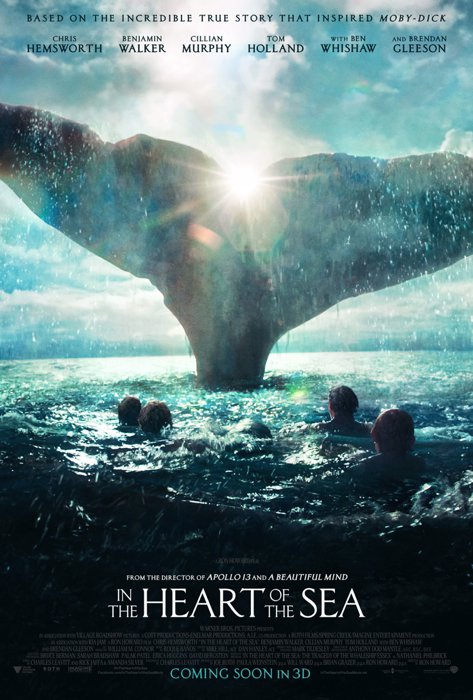
A common refrain from detractors of director Ron Howard is that he has no distinctive style of his own, and it's impossible to define inherently what is "a Ron Howard film". While it's true that he varies unpredictably from one genre to another and does not provide his films with a singular worldview as many aueteurs might do, we offer that there is a definite answer to what a Howard film is: it's Opie Taylor saying "Pa, I wanna be an astronaut" or "I wanna be a firefighter"or boxer or race car driver or whatever, and then living that experience and taking us with him. Where other filmmakers might choose simply to tell a story set in the world of a particular pursuit, Howard wants the visceral experience of what it's like to live that pursuit,  and more than any other director working today he wants to put us inside that experience. With his his new film, In the Heart of the Sea, he gives us that experience with the sea-faring life of the 19th century, and does so with every bit of his considerable visual and technical skill.

Based on Nathaniel Philbrick's bestseller of the same name, In the Heart of the Sea tells the story of the Essex, a whaling ship said to be the inspiration for Moby Dick. In fact, the film's framing device involves a young Herman Melville (Ben Whishaw) meeting with a survivor of the Essex and hearing his story. The survivor is Thomas Nickerson (Brendan Gleeson), who had just begun his sailing career as a fresh-faced 14 year old (played at this age by Tom Holland, Marvel's new Spider-Man), and the the bulk of the film is clearly from the point of view of its chief protagonist, First Mate Owen Chase (Chris Hemsworth). This is a problem with the narrator framing device which frequently frustrates and confuses us: your storyteller can't provide the point of view and first hand account of events for which he was not present. It simply doesn't make sense. Anyway, The Essex sails out in search of whale oil, but runs into an encounter with an enormous white whale which puts the crew in a desperate and harrowing struggle to survive.

From a visual and technical standpoint, this ranks with Howard's best work, which is high praise. His eye for shot selection and skill with guiding the camera's movement ranks among the best in Hollywood today, and here he creates several eye-popping sequences, helped along by cinematographer Anthony Dodd Mantle and by his longtime editors, the great Mike Hill and Dan Hanley (who deserve serious Oscar consideration for this one). Howard also admirably creates the feeling of being stuck on board a cramped vessel, and actually plays the ship as small as it should be instead of letting it seem huge for the sake of convenience.  Howard has made us part of the sailing and whaling experience here as expertly as he's brought us into spaceflight and firefighting.

The weakness of In the Heart of the Sea is that the characters aren't nearly as engaging as the ones in Apollo 13. Hemsworth is certainly capable of carrying a film, but Chase's character arc is largely consumed by a mutual frustration and rivalry between himself and new Captain George Pollard (Benjamin Walker). While the evolution of the relationship between them eventually becomes quite compelling, it's a slow burn which leaves us no one with whom to bond and identify for the first half of the film, and this keeps us from getting as emotionally engaged as we want to be. Additonally, for all it's harrowing (and sometimes disturbing) human drama of survival,  the film never reaches the point where it feels it has anything of great importance to say, or any truly deep insight, despite an all around solid cast of performers.


However, In the Heart of the Sea is above all else an epic seagoing adventure, and there's no question
Howard has succeeded at providing that with with skill and vision.  It's a superb piece of directorial virtuosity, and if it fails to be as emotionally satisfying as it wants to be, it's still spectacular filmmaking.

Wednesday, November 25, 2015

THE GOOD DINOSAUR


Starring the voices of Raymond Ochoa, Jack Bright, Sam Elliott, Steve Zahn, Anna Paquin, Jeffrey Wright
Screenplay by Meg LeFauve

Directed by Peter Sohn

Rated PG (Violence, intensity, mayhem, crude humor)

Reviewed by Patrick Gibbs

20 years ago last week, the face of animation was changed forever when Disney-PIXAR gave us their debut film, Toy Story.  Initially viewed as a gimmick or a novelty, this instant classic arguably impacted not only animation but film as a whole more than any other movie of the past two decades. After producing multiple classics, the ground breaking company turned mega empire seemed to be running out of ideas, until this summer's Inside Out was praised (and rightly so) as a strong contender for the studio's best film to date. After riding so high these past few months, some cynics have been skeptical that lightning could strike twice with the group releasing two major movies in one year, and some seriously doubted that The Good Dinosaur, a project that encountered so many troubles behind the scenes that the entire voice cast was fired and replaced with a fresh batch of actors, would deliver, and that it was too much to ask for another truly magical entry from Pixar this holiday season.

Sometimes, the cynics are right.

The new film is ostensibly set in "an altenate timeline" in which the Earth was never hit by by an asteroid, and dinosaurs never became extinct. If this sounds like an intriguing idea to you, prepare for a major letdown, because it goes absolutely nowhere. Instead of exploring the idea of these creatures evolving, or speculating as to how dinosaurs and humans could co-exist, this is merely a lazily inserted excuse to justify the lead character having a pet human kid. It's hard to watch the movie and not picture one executive listening to the pitch and saying "dinosaurs and humans never lived at the same time, you know," only to have the embarrassed writers, who probably grew up watching Caveman, grasping for an explanation that would save their premise, screaming "it's meant to be in an alternate timeline, jerkface!" and going home to have a good cry. The part that is harder to fathom is how John Lassiter ended up signing off on the follow up pitch that seems to have consisted of "It's E.T. and The Jungle Book meet The Grapes of Wrath, Little House on the Prairie and Deliverance, but there are dinosaurs!"

The story centers around Arlo, a young Apatosaurus who lives on a farm with his Mama and Papa and brother and sister. Arlo is the runt of the litter, and he wants to make his mark, literally: when a dinosaur comes of age, it dunks it's foot in mud and leaves an imprint above the door of the house. But Arlo can't seem to do anything right, and and after he can't go through with clubbing a human baby to death (one could almost hear Donald Trump saying "no wonder these things became extinct. I was clubbin' babies to death when I was four, and I didn't even have a reason. I'll bet dinosaurs weren't even born in this country."), Dad takes junior for a walk in the rain, and tragically, Mufasa is killed by a stampeding flood while Simba watches helplessly as we find our bored, wandering minds contemplating whether Jeremy Irons will make a good Alfred.

After this, things start to get grim, as Mama starts to worry that they will lose the farm. An angry Arlo loses it when he sees the man child whom he blames for his father's death, chasing him until they get hopelessly lost and run across a group of savage and carnivorous pteranadons, whose spokesman, Thunderclap, seems to be some sort of cult leader/religious fanatic (voiced capably but charmlessly by Steve Zahn.).

If this is starting to sound like a jumbled mess, that's only because it is. The story fares best when it centers on simplicity and understated interaction between Arlo and the boy, whom he names Spot. There are genuine moments here, and while these are hardly two of the great characters in Disney history, they are kind of cute together. There are also some pleasant sequences with a family of T-Rex (Sam Elliott abides as the father, and made the whole movie for me.). But whenever it gets caught up in being an unflinching portrayal of the hardships suffered by pioneers settling the American frontier, you have to wonder exactly who this is supposed to be aimed at and for that matter, why? It's too dark and violent for little ones, too slow for older kids, and frankly, there is really only one truly clever line in the entire picture.

You are probably getting the idea that I hated this movie. I did not.

1. There's an abundance of gorgeous imagery, primarily in the form of scenery. The water, and the deserts, are some of the most strikingly realistic work Pixar has ever done (although that makes the choice to make the dinosaurs themselves look so cartoonish and slap dash that they would seem more at home on a Disney Channel daily series than a major motion picture that much more questionable.).

2. The musical score by Michael Danna (Ang Lee's pet composer) is quite lovely

3. I don't think I am capable of genuinely hating an animated feature.

But forget comparing The Good Dinosaur to Inside Out. In fact, forget comparing it to The Croods. In the search for a high profile film that this really reminded me of, the best I could come up with was (get ready for this) Robots.

It's important to note that audience members leaving the free screening were walking out praising the film as one of the best they've seem in a while, or at least it would be if I had not been doing this long enough to know that people who are given free passes to an advance screening will say this about any movie from The Beverly Hillibillies to Battleship.

When it comes down to it, The Good Dinosaur is mildly diverting, mildly exciting, relatively cute when it's not being off-puttingly nasty, and it's bound to sell some toys. Kids seemed to really respond to the potty humor (not that there was a lot if it, but it got a huge reaction, possibly because there were so few moments to really laugh at) and again, some of the imagery is really astonishing. But at the same time, if I really feel the need to see what water looks like in 3D, I can fill up my bathtub for free.

CREED

CREED 


Starring Michael B. Jordan, Sylvester Stallone, Tess Thompson, Phyllicia Rashad and Graham McTavish

Screenplay by Ryan Coogler & Aaron Covington
Based on characters created by Sylvester Stallone

Directed by Ryan Coogler

Rated PG-13 (profanity, boxing violence, adult themes)

It's easy to forget just how good the original 1976 Rocky was, and how good Sylvester Stallone was in it. While for our money, 2006's Rocky Balboa was a glorious and rousing (if a bit far fetched) return to form, there's no denying that at the height Stallone's Hollywood stardom, the series started to stray from it's blue collar, sincere heart and soul and into blockbuster silliness. In particular the high-grossing Rocky IV, took the franchise in such a cartoonish direction (putting Phildelphia's favorite son right at the front lines of the Cold War, to say nothing of the subplot about Paulie getting a robot for his birthday) that the sheer emotional power of the original was forgotten, even if it never truly lost its entertainment value. But considering that Rocky Balboa succeeded so decisively in ending the series with class and dignity, Stallone was taking a big risk by not only bringing the Italian Stallion back for one more round, but for the first time letting someone else write the screenplay. But Sly's trust in Ryan Coogler was well-placed. Creed is a big success.

The story is such a strong and obvious one that it's a wonder Stallone didn't come up with it himself: Rocky comes out of retirement to train the son of the late Apollo Creed. What's surprising is that Stallone had the savvy and humility to let Creed the younger (actually named Adonis Johnson) take center stage, making Rocky Balboa a supporting character for the first time in seven films. It pays off wonderfully, allowing both actors to shine and to demonstrate first-rate chemistry with each other. But while Jordan demonstrates he's a talented and charismatic actor with real potential as a leading man, this is still Stallone's show, and it's always at its best when he takes the spotlight. We would assert that no other actor and character of the 20th Century are as synonymous with each other as Stallone and Balboa, and he's never played the role better than he does here. At this age, Rocky may still be a simple guy, but there's a great deal of wisdom and maturity in that big, brutish but lovable package, and the aging icon imbues his signature role with so much sincerity and emotion that it's hard to not place harsh judgement on anyone who doesn't tear up at least a couple of times, especially in relation to film's biggest dramatic complication:

SPOILER ALERT, EVEN THOUGH THIS IS 
IN THE TRAILER, SO IT'S NOT REALLY A SPOILER, BUT THERE'S ALWAYS GOING TO BE SOMEBODY WHO'S UPSET ANYWAY . . .

Are you still there? Okay.

Rocky's battle with cancer. Rocky's reaction to the news is a very powerful scene that may be the superstar's finest on screen acting, but most of all the final scene, set in what Rocky calls his favorite place, ranks among the most emotional in the franchise's history. And considering its pop culture significance, it's even more than that.

The weakest aspect of the film is probably the romance between Adonis and a young musician named Bianca (Tessa Thompson). It's not a bad romantic subplot, and it's likely younger audiences who are less familiar with the series will enjoy it more than we did. But while both Jordan and Thompson are likable and talented, during those scenes it was hard not to just want to get back to Adonis and Rocky.

Director Coogler makes it clear from the beginning that he's making a contemporary Ryan Coogler/Michael B. Jordan film, but he balances that with a loving respect and devotion to the source material that makes for a highly satisfying and thrilling combination. Coogler not only handles the drama very well and seems to have a lot of talent for working with actors, he pulls off some truly impressive visuals. In particular Adonis' first on-screen fight, filmed in one continuous shot, is a triumph of staging and cinematography, and it's no mere gimmick. The long take adds a great deal to the feeling of being in the ring with Adonis without feeling distractingly flashy. While this summer's Southpaw, capably directed by Antoine Fuqua, left us feeling there was no new way left to shoot a boxing match, Coogler proved us wrong. The Fruitvale Station auteur promises to be to be a major new talent. He and composer Ludwig Gorannson also know exactly when and where to use Bill Conti's iconic theme to maximum effect, which is no small part of making the film work as near-perfectly as it does.

In the end, the best compliment that can be paid to Creed may be that it leaves us just hoping The Force Awakens will be as good a Star Wars movie as this is a Rocky movie. Coogler, Stallone and Jordan have succeeded marvelously at creating a major new chapter in a franchise that conventional wisdom says should have sputtered out long ago. But never count  a true champion out until the final bell rings.

Friday, November 6, 2015

THE PEANUTS MOVIE


THE PEANUTS MOVIE
Starring Noah Schnapp, Alexander Garfin, Bill Melendez, Kristin Cheoweth
Based on the Comic Strip by Charles M. Schulz
Screenplay Bryan Schulz & Craig Schulz and Cornelius Uliano
Directed by Steve Martino
Rated G

Reviewed by Paul Gibbs & Patrick Gibbs


Of all the Charlie Brown movies in the world, this one is the Charlie Browniest.

Far too often, modern incarnations of beloved childhood cartoons rob the source material of its original charm (if it actually had any, which is not always the case in this age where we view every last 1980's property through the veil of rose colored nostalgia) by adding a hip feel or a sarcastic edge. Neither of those things has any place in the world of Charles Schulz, which is so innocent and square it makes Happy Days look like a Todd Solondz creation (Todd Solondz is ... never mind). The cartoons and comic strips are beloved to millions, but not because they were cool, or even uproariously funny. There is an unmistakable charm, and a relatability to the characters that makes them an indelible part of childhood for many of us. Fortunately, Schulz' family was heavily involved in The Peanuts Movie, and the result is a film which captures and is true to the tone and spirit of the material. The only concession to modernization is the soundtrack, which includes the sort of songs you'd expect to hear from Disney Channel stars, but they are never more than mildly distracting and actually fit the film better than you might expect. Plus, there's plenty of Schroeder's piano to balance them out.

The story deals with our protagonist, the hapless Charlie Brown (nicely voiced by Noah Schnapp, who played Tom Hanks' son in Bridge of Spies), experiencing one of the defining moments of his life: the legendary Little Red- Haired Girl (Francesca Capaldi) has just moved in across the street and started going to his school. Charlie Brown (why does no one ever just call him Charlie?) is instantly smitten, but he's afraid to even speak to her for fear that he's too much of a loser and a nobody. After receiving typically dubious psychiatric advice from Lucy Van Pelt (Hadley Bell Miller), he decides to prove himself worthy by impressing her with a major accomplishment, but this is easier said than done. Meanwhile, his dog Snoopy (voiced by archival recordings from animator/original Snoopy Bill Melendez) has started fantasizing about being a World War I Flying Ace who fights infamous Red Baron and romances a poodle named Fifi (Broadway legend and would-be Helium spokeswoman Kristin Chenoweth, who has quite frankly, in our opinions, never really been successfully utilized in a major film before, whether due to bad casting choices, direction or writing, but a perfect and hilarious choice to provide a high pitched, feminine "drop kick dog" counterpart to Snoopy's vocalizations.).

The story doesn't amount to much more than this, but Peanuts was never about intricately plotted stories. And all of the classic elements are here: the Kite Eating Tree, Linus' blanket, Lucy and the football, etc.  In fact, it's all so true to these classic elements that it may feel to some like they're just repeating old material, and that's a fair observation. But for those of us who grew up on it, there's a delightful nostalgia to the proceedings, and it should easily be entertaining enough for younger viewers who are less familiar with Charlie Brown and company. And there's a good message about learning to like yourself for who you are. It's also an excellent choice not over-plot the film or add an unnecessary and out of place villain. It is what it always was, and that's what it should be.

The choice to take 2D animation and convert it to 3D CGI with characters who maintain the look of 2D, then present it in Real D 3D, is an odd one, but it works. The characters are exactly their old selves, and the 3D gives the sensation of being inside Charlie Brown's world, something most of us probably wished we could do (the film would also certainly play well in 2D presentations).

All in all, The Peanuts Movie is an overwhelming success that's about as close to perfect as a Peanuts movie could hope to be. Our childhood memories not only remain intact, they've been enhanced by this welcome chance to revisit them.