Reviewed by Patrick Gibbs
GRADE: D
Greg Kinnear, Kelly Reilly, Thomas Haden Church,Connor Corum, Margo Martindale
Based on the book by Todd Burpo and Lynn Vincent
Screenplay by Chris Parker and Randall Wallace
Directed by Randall Wallace
Randall Wallace got off to a big start in Hollywood by penning the script for Mel Gibson's Oscar sweeping epic Braveheart, based on his own original novel. True, Braveheart was a heavy handed, hokey, and sometimes trite screenplay, but it was also emotionally stirring, filled with some great speeches and memorable dialogue that was reminiscent of Robert Bolt, in particular A Man For All Seasons. Far less impressive was his thoroughly idiotic script for Michael Bay's travesty Pearl Harbor, and his directorial debut, The Man In The Iron Mask, was Leonardo DiCaprio's Robin Hood: Prince Of Thieves, but frankly much more pretentious and not nearly as much fun.We Were Soldiers was not great, but it was a major step up, though one couldn't help but feel that Mel Gibson's guiding hand lifted the quality of the film. It wasn't until Secretariat that Wallace seemed to be genuinely settling into a groove and becoming a solid, if uninspired, filmmaker, making his next project worthy of anticipation.
Heaven Is for Real begins with a young girl in Lithuania painting a portrait, and then shifts to Nebraska, where we meet Todd Burpo (Greg Kinnear), a handsome Pastor withmovie star good looks but a down to earth, every man "you gotta love this guy" personality that he apparently achieved by watching every episode of Seventh Heaven three or four times. When Todd isn't giving entertaining if meaningless sermons about lions and unicorns, he's playing baseball or working as a volunteer firefighter (if he has any spare time after that, he presumably spends it baking delicious apple pies and wrapping himself in the American flag.).
While on a trip to Denver, Todd's four-year-old son Colton (Connor Corum) gets sick. Very sick. He is taken to the hospital, where he nearly dies on the operating table. When Colton awakens, he says he went to Heaven. He talks about looking down to see the doctor operating, and
his Mom (Kelly Reilly) praying in the waiting room while his Dad "yelled at God" in the chapel. he also says he met Jesus.
The family doesn't know what to
believe. In Heaven, Colton says he met his miscarried sister whom no one
had ever told him about and his great-grandfather who died 30 years
before Colton was born. He shared supposedly impossible-to-know details
about each. Colton went on to describe the horse that only Jesus (who has brown hair and bluish green eyes) could
ride a horse, about how “reaaally big” God and His chair are, and plenty of other interesting tidbits. It's not long before the community is in an uproar about all of this Jesus talk (because if there's one thing small town middle America can't abide, it's a Jesus freak.) and the family must come to a decision of how to face the situation, and to decide for themselves if Connor is telling the truth.
Heaven Is For Real manages to be embarrassingly syrupy and heavy handed, while at the same time continually stopping short of committing to what it is trying to say, or what it believes. Wallace tries to fill us with constant warm fuzzies but never once delves beneath the surface to explore the complexity of religion and the nature of man's relationship with God. In fact, after Kinnear's final sermon about his son's visit to Heaven, one is left to feel that perhaps a more appropriate title would have been Heaven Is Absolutely Honest To God Real I Think, Probably, But Actually It Might Just Be Metaphorical, And Whatever You Personally Believe Is Exactly What I Believe, Too but of course, Hollywood has a rule that it reserves it's clunkiest titles for Lee Daniels.).
Kinnear is likable enough, but far too old for the role of the thirty-something Burpo, which is constantly reinforced by how ill matched he is with Reilly. Young Connor Corum is cute but awkward, trying hard but never truly feeling real (one has to wonder what kind of a performance he might have given with the guidance of a more seasoned actor's director.). The film's production values are mediocre, and it would be easy to mistake it for a Lifetime TV Movie if it wasn't for Wallace's constant failed attempts to do interesting things with the camera. (In particular, a sequence where the board of the church meets with Todd is so hyper active in it's Michael Bay style "dolly around the converstaion" approach that it caused more motion sickness in me than Gravity.). But by far the WORST choice Wallace makes as a director is in his depictions of Colton's time in Heaven: it's almost as if, because this was a best selling book, Wallace decided to mimic the look and production design of Reading Rainbow. In truth, the story is clearly being told from Todd's point of view, as established from the painfully slow moving character establishment section of the film. This movie is portrayed most of the time as the story of the people hearing Colton's tales and trying to decide if they are true, and as such, we really should not have seen these moments portrayed literally and visually at all.
But the crowning touches that raise this film to the level of truly awful are 1. The jaw dropping amount of emphasis given to Colton's love of Spider-Man, which is of course totally coincidental and has nothing whatsoever to do with the fact that the studio, Columbia Pictures, desperately needs The Amazing Spider-Man 2 to establish their reboot into a tentpole franchise and can use every bit of advertising they can get, and 2. the manipulation of facts and outright lies in storytelling. Remember that little girl in Lithuania? At the end of the film she is being featured on CNN, living on another continent and showing off her painting of Jesus which is based on her visions. When Colton sees the man in the painting, he says "That's him! That's what He looks like." The little girl is revealed in the ending crawls to be Akianne Kramarik, a real life prodigy. But while the real Akianne is the daughter of Lithuanian parents, sheactually born and raised in Illinois, and though she does claim to have spoken to God and received vision and instruction form Him, the rather significant detail that she used a model for her painting of Jesus, and that other paintings she did of him do not match up, is completely left out, and the connection between Akianne's visions and Colton's is pretty much all fiction. If you are going to tell an inspiring story about proof that God is real, don't you dare make things like that up! Not only does it make you look foolish, it makes everyone who believes in the story into fools. In reality, though this film is likely to be far more embraced by the religious right than Darren Aronofsky's Noah, considering that the story it's based on happened barely a decade ago, it plays far more fast and loose with established accounts and throws in far more disrespectfully phony elements.
In the end, as some one who believes in God, and in Jesus, and does indeed believe that Heaven is for real, I did not buy a single moments of this insipid and manipulative piece of Hollywood hokum, and I found it to be genuinely insulting to its target audience.
Heaven Is For Real is rated PG "for thematic material including some medical situations."
Wednesday, April 16, 2014
Thursday, April 10, 2014
DRAFT DAY
Grade: B
Starring Kevin Costner, Jennifer Garner, Dennis Leary, Chadwick Boseman, Tom Welling
Written by Scott Rothman and Rajiv Joseph
DIrected by Ivan Reitman
Rated PG-13
Reviewed by Paul Gibbs
Westerns and sports movies (usually baseball) were always Kevin Costner's most comfortable genres. His recent comeback began with a western of sorts with the acclaimed history channel miniseries Hatfields & McCoys, and now he's finally back playing the lead in a major theatrical film in the football comedy/drama Draft Day.
Costner plays Cleveland Browns General Manager Sonny Weaver, Jr, a man desperate to prove himself worthy of his job in a town obsessed with sports. On an NFL draft day that's already shaping up to be the biggest of his career, the general manager of the Seattle Seahawks (who apparently did not just win the Super Bowl in this reality) calls him up and offers him an incredible deal: the number 1 overall pick in exchange for his next three picks. This happens to be in a year when the almost certain number 1 pick is Bo Callahan (Josh Pence), a superstar quarterback everybody thinks will redefine the term franchise player.
The rest of the film is reminiscent of Ron Howard's 1994 drama The Paper, as we glimpse a day in the life of this job while Weaver juggles a Coach (Dennis Leary) who fights him on everything, a mother (Ellen Burstyn) who is dealing with the grief of the recent death of Sonny's father, and a secret office girlfriend (Jennifer Garner) who just found out she's pregnant.
Director Ivan Reitman handles the comic and dramatic elements of the film nicely, but he makes some hyper stylized visual choices that get old the first time he uses them, and he unfortunately beats them into.the ground. The choices are bit puzzling from a no nonsense veteran like Reitman, and, to use an absurd analogy, play like a desperate, aging has been overcompensating for the fact that he hasn't made a really good movie since Kindergarten Cop and trying not to be upstaged by his own son (sorry for creating such a ridiculous scenario).
This is a movie that lives or dies on its cast, and thankfully, they deliver. Costner effortlessly brings back the charm and star quality of his heyday, showing the young stars of today how it's done so well that it makes you wonder why he ever slipped (hint: The Postman). He and Garner are even surprisingly credible together, especially considering that there's actually some vague acknowledgement of the age difference. And the conflict between Costner and Leary adds tension, with Leary memorable as an obnoxious jerk who you can't help thinking might be right a lot of the time.
In the interest of full disclosure, I have to say that I personally find football as interesting as Ben Stein giving a lecture on athlete's foot. And the storyline is formulaic and predictable. But it's a formula that works, mostly because Costner offers such a great star turn. Most audiences are likely to be pulled into this simple but engaging film whether or not they like the sport.
Draft Day is rated PG-13 for profanity and implied sexuality.
Thursday, April 3, 2014
CAPTAIN AMERICA: THE WINTER SOLDIER
GRADE: A
Starring Chris Evans, Scarlett Johanson, Sebastian Stan, Samuel L. Jackson, Robert Redford
Screenplay by Christopher Markus and Stephen McFeely
Directed by by Anthony Russo and Joe Russo
Reviewed by Paul Gibbs
The Marvel universe is to the 2010's what Star Trek was to 90's: a massive, interconnected and omnipresent franchise full of different part that have to be correlated. Eventually Trek sputtered out because of over saturation and choking on its own continuity, and Marvel threatens to do the same, especially with its TV series Agents of S.H.I.E.L.D. thrown into the mix. But for now they're still consistently turning out some of the most entertaining popcorn fare Hollywood is offering, and Captain America: The Winter Soldier ranks with their best.
The story begins with Captain America/Steve Rogers still working for S.H.I.E.L.D. (in the division that employs buff soldiers, rather than the one filled with wise-cracking 22 year old geeks), and Rogers is having more and more doubts about the direction S.H.I.E.L.D. is taking, one where it's more than willing to trample a few freedoms and civil liberties here and there in the name of peace and security (you can tell the politics of a viewer by whether they see this as a reference to Bush's war on terror or Obama's drone program). In partciular, Rogers clashes with S.H.I.E.L.D. director Nick Fury (Samuel L. Jackson) and his nominl partner Natasha Romanov (Scarlett Johansson) , neither of whom share his black and.white.view of honesty and integrity. Rogers' one friend and confidant seems to be Afghan war vet Sam Wilson(Anthony Mackie), Steve he meets while doing his morning run.
When a surprise attack is carries out on a high-ranking member of S.H.I.E.L.D. (carried out by a mysetious, legendary assassin called The Winter Soldier who seems to share many of the Captain's abilities) , Rogers and Romanov go on the run, and the film becomes a government paranoia spy thriller, and a rather good one. It's impressive how well Marvel vert screenwriters Christopher Markus and Stephen McFeely and directors Anthony and Joe Russ mesh this feel with the more overtly comic booky aspects of the film without shortchanging either. The Russo give the film a brisk pace and some thrilling chase/action sequences, utilizing a lot of the steadicam/staccato shutter speed style that the Bourne films made popular, while still keep the fights easy to follow and never terribly confusing. Evans remains a likeable and relatable hero, and his supporting cast is generally very strong, with Johansson and Jackson adding new layers to their portrayals, and Mackie and screen legend Robert Redford as welcome new additions to the franchise. And all of these actors are allowed the chances to do some genuine character work that brings humanity to a spectacular action film. All together it adds up to an outstanding sequel to both the first Captain America and The Avengers that is arguably the most complete and all-around successful of Marvel's individual franchise sequels.
If you're burned out on superhero movies or just not big on the Marvel universe, this isn't likely to make you change your mind. But you don't have to the kind of die hard fan who knows who Sam Wilson turns out to be to have a great time. This is likely to stack up well against even most of the the better blockbusters of the summer.
Captain America: The Winter Soldier is rated PG-13 for mild profanity and quite a bit of action violence.
GRADE: A
Starring Chris Evans, Scarlett Johanson, Sebastian Stan, Samuel L. Jackson, Robert Redford
Screenplay by Christopher Markus and Stephen McFeely
Directed by by Anthony Russo and Joe Russo
Reviewed by Paul Gibbs
The Marvel universe is to the 2010's what Star Trek was to 90's: a massive, interconnected and omnipresent franchise full of different part that have to be correlated. Eventually Trek sputtered out because of over saturation and choking on its own continuity, and Marvel threatens to do the same, especially with its TV series Agents of S.H.I.E.L.D. thrown into the mix. But for now they're still consistently turning out some of the most entertaining popcorn fare Hollywood is offering, and Captain America: The Winter Soldier ranks with their best.
The story begins with Captain America/Steve Rogers still working for S.H.I.E.L.D. (in the division that employs buff soldiers, rather than the one filled with wise-cracking 22 year old geeks), and Rogers is having more and more doubts about the direction S.H.I.E.L.D. is taking, one where it's more than willing to trample a few freedoms and civil liberties here and there in the name of peace and security (you can tell the politics of a viewer by whether they see this as a reference to Bush's war on terror or Obama's drone program). In partciular, Rogers clashes with S.H.I.E.L.D. director Nick Fury (Samuel L. Jackson) and his nominl partner Natasha Romanov (Scarlett Johansson) , neither of whom share his black and.white.view of honesty and integrity. Rogers' one friend and confidant seems to be Afghan war vet Sam Wilson(Anthony Mackie), Steve he meets while doing his morning run.
When a surprise attack is carries out on a high-ranking member of S.H.I.E.L.D. (carried out by a mysetious, legendary assassin called The Winter Soldier who seems to share many of the Captain's abilities) , Rogers and Romanov go on the run, and the film becomes a government paranoia spy thriller, and a rather good one. It's impressive how well Marvel vert screenwriters Christopher Markus and Stephen McFeely and directors Anthony and Joe Russ mesh this feel with the more overtly comic booky aspects of the film without shortchanging either. The Russo give the film a brisk pace and some thrilling chase/action sequences, utilizing a lot of the steadicam/staccato shutter speed style that the Bourne films made popular, while still keep the fights easy to follow and never terribly confusing. Evans remains a likeable and relatable hero, and his supporting cast is generally very strong, with Johansson and Jackson adding new layers to their portrayals, and Mackie and screen legend Robert Redford as welcome new additions to the franchise. And all of these actors are allowed the chances to do some genuine character work that brings humanity to a spectacular action film. All together it adds up to an outstanding sequel to both the first Captain America and The Avengers that is arguably the most complete and all-around successful of Marvel's individual franchise sequels.
If you're burned out on superhero movies or just not big on the Marvel universe, this isn't likely to make you change your mind. But you don't have to the kind of die hard fan who knows who Sam Wilson turns out to be to have a great time. This is likely to stack up well against even most of the the better blockbusters of the summer.
Captain America: The Winter Soldier is rated PG-13 for mild profanity and quite a bit of action violence.
Thursday, March 27, 2014
NOAH
Reviewed by Patrick Gibbs
GRADE: A
Russell Crowe, Jennifer Connelly, Emma Watson, Anthony Hopkins, Ray Winstone, Logan Lerman,
Written by Darrren Aronofsky and Ari Handel
Directed by Darren Aronofsky
When you hear that someone is making a modern biblical epic, the name Russell Crowe is hardly a surprise name to be tossed around. To quote Chris Rock, "If your movie is set in the past, you best be casting Russell's ass." Grand, old style Hollywood epics like GLADIATOR are where he seems most at home (though I will always maintain that CINDERELLA MAN is actually his overall most endearing performance.). But when picking a director for a Bible story, especially "Noah's Ark," names like Ridley Scott or Mel Gibson may immediately spring to mind, but Darren Aronofsky is one name that decidedly does not.
The director of such heavy, R-Rated and explicit art house fare as Requiem For A Dream and Black Swan is not exactly the most Sunday School friendly presence. The only thing that really seems obvious about the match of director to material is that if there is anyone who could unflinchingly portray a human race so far gone that it seemed justified to wipe them out, it may be Aronofsky. But this is a PG-13. What's more, it's a $125 million dollar blockbuster wannabe. What was the studio thinking? What was the director thinking?
The answer is as complex as the movie itself.
The film begins with, well . . . the beginning, quoted straight from the bestselling book. "There was nothing, not even light." Then it tells the story of Adam and Eve in the Garden of Eden, of Cain and Abel, and the mark put upon Cain as he committed the first murder. Familiar, right? But wait, there's more: it also tells the story of "The Watchers," a group of fallen angels who were cast out of heaven for taking pity on Adam and Eve and trying to help them. The Watchers were trapped inside the earth itself, and took the form of rock giants. Imagine if Optimus Prime and "The Thing" from Fantastic Four both had liasons with Treebeard's sister and you couldn't quite figure out which one was the father. Actually, don't, that's disturbing.
Noah (Russell Crowe) is a good man, descended from Seth, and perhaps the last religious man on the planet. Noah follows the teachings of "The Creator," and along with his wife Naameh (Jennifer Connelly), raises his children to do so as well. He also raises an adopted daughter, Iila, whom he found dying of a stomach wound which would leave her barren when she grows into a beautiful young woman played by Emma Watson.
One day, Noah has a vision: the creator is going to destroy the world. Confused by this vision, he goes to speak to the only man he can trust, his grandfather, Methuselah (Anthony Hopkins.). As the two converse and discuss the designs of the creator, Noah has a further revelation that the destruction will come in the form of a flood, destroying all mankind. Naturally, Noah immediately becomes a boating enthusiast and starts plans to build an ark. But it's not long before we meet our villain, Tubal-Cain (played by Ray Winstone, because Edward G. Robinson refused to return Aronofsky's phone calls on the grounds that he has been dead for 40 years.). Tubal-Cain is the would be king of the people of Cain, and he believes the creator has abandoned man, and therefore they must take care of themselves and do as they feel. This wickedness is seen mostly in the form of violence against animals (Noah and his family are vegetarians), but we also see women being traded as slaves, and a general willingness to kill anything that gets in Tubal-Cain's way. But when he hears that Noah is building an ark, he wants a reserved seat, just in case, but Noah's faithful rock giant friends make good junkyard dogs. (Seriously. Rock giants. I am not making this up.). Tubal-Cain and his people leave, and Noah and Naameh get in a fight when Noah refuses to let his sons go out and get themselves wives to take with them on the journey. Noah has seen that evil lies in all men, including himself and his family. He concludes that it is the Creator's will that he save the animals, who are innocent because they still live as they did in the garden, but that eventually man must perish from the earth. Noah's oldest son, Shem, is okay with this, because he has a hot but barren girlfriend (a must for any man going on the last cruise in existence), but the next in line, Ham (Logan Lerman, of the Percy Jackson films) is pretty upset by the idea of being sentenced to a life of loneliness and . . . well, you know, loneliness.
Of course, when the rain comes down, the floods come up. The family takes to the high seas, the skipper brave and sure that his harsh insistence on not letting anyone else on board, despite plenty of room, is what must be done. But a resentful Ham just might be hiding a stowaway.
This is certainly not for everyone, but it plays much better than it sounds like it would. In fact, much of the film is genuinely mesmerizing. But at times it becomes as lost as as giant block of wood floating through a deluge. This is unquestionably an art film, yet it has some jaw dropping, overblown Hollywood blockbuster elements. When you say that this is a version of Noah's Ark where the bad guy is firing a flare gun at rock giants, it sounds like you're talking about Michael Bay, not Aronofsky. But this really is an Aronofsky film all the way, for good or bad. It manages to be thought provoking, silly, epic, intimate, profound, inane, brilliant, and stupid all at the same time, and the thing is, for the most part, THAT ACTUALLY WORKED FOR ME. Let's face it: this is a pretty Hollywood story, and in the end, this does not stray nearly as far from the source material as you may think while watching it. Honestly, right down to Jennifer Connelly being in it, the film I would most compare it to is Ang Lee's Hulk, in terms of a deep, thoughtful artist trying to go full Hollywood while remaining true to his artistic nature and as a result making a movie that really works for a certain crowd of people and leaves everyone else utterly puzzled and angry.
The film is at its definitely at its best when it is going the more arsty route, and in particular a sequence where Noah tells the story of the creation and the fall of Cain to his family to explain why they must do what they are doing, is beautifully done and will likely be the most memorable sequence in any film this year, equally effective for believers and non believers alike. Aronofsky uses the iconic biblical tale to explore the relationship between man and God in any time period, and captures the feelings of gratefulness, humility, confusion, resentment, supplication, trust, judgement, forgiveness, and love that come with living a devoutly religious life, and that is no small feat. It's not just about one family's tumultuous journey through the ocean while trying to trust in God, it's about the journey we all take through life trying to do the same.
The Watchers work far better than they have any right to (and are not a completely made up element: they come from Jewish legend and the non canonical Book of Enoch) and I probably would have just gone with them if it wasn't for the added Hollywood touch of the evil stowaway to provide a fight scene that seems straight out of Die Hard. In addition, while it is clearly understood that Aronofsky wants to set the story in such an undetermined time and place that the word "anachronism" is a bit hard to apply, the welding mask and the home pregnancy test strain credibility (again, it sounds worse than it is, especially the latter.).
The performances are strong all around, with Crowe in top form, with a fascinating take on Noah as alternately the lovably sympathetic prophet carrying a heavy burden, or the heartless and dangerously egocentric religious fanatic, depending on how the characters see him at different points throughout the film. Hopkins makes a delightful Methuselah and Watson steals the whole movie with a heart felt monologue toward the end that provides the most spiritually uplifting moment, and her chemistry with Crowe is undeniable. Logan Lerman, a very subtle and natural actor who had the misfortune of giving a terrible performance in Paul W.S. Anderson's dreadful Three Musketeers, is saddled with some of the most compelling moments but also some of the silliest, but his earnestness makes it work. Fairing worst is Ray Winstone as the requisite baddie, which unfortunately is becoming a paragraph I could cut and paste into almost any review these days. As usual for an Aronofsky film, the score by Clint Mansell and cinematography by Matthew Libatique are both stunningly gorgeous, if not terribly subtle.
My final opinion on this one is hard to solidify, and I'll probably jump around a lot on what I thought. In the end, I believe that anyone who completely embraces the film as truly great or utterly dismisses it as terrible is making a hasty judgement that is hard to back up artistically and is more likely based on whatever end of the religious spectrum they are on. But that being said, it could actually go either way which side goes with which conclusion, which is one of the biggest reasons I will not be able to get this movie out of my head for some time. Aronofsky's films can be accused of being many things. Forgettable is not one of them.
Noah is rated PG-13, but should probably be a light R for violence and adult themes. This is not a movie to take your kids to for a number of reasons, but most of all because it is just so heavy.
GRADE: A
Russell Crowe, Jennifer Connelly, Emma Watson, Anthony Hopkins, Ray Winstone, Logan Lerman,
Written by Darrren Aronofsky and Ari Handel
Directed by Darren Aronofsky
When you hear that someone is making a modern biblical epic, the name Russell Crowe is hardly a surprise name to be tossed around. To quote Chris Rock, "If your movie is set in the past, you best be casting Russell's ass." Grand, old style Hollywood epics like GLADIATOR are where he seems most at home (though I will always maintain that CINDERELLA MAN is actually his overall most endearing performance.). But when picking a director for a Bible story, especially "Noah's Ark," names like Ridley Scott or Mel Gibson may immediately spring to mind, but Darren Aronofsky is one name that decidedly does not.
The director of such heavy, R-Rated and explicit art house fare as Requiem For A Dream and Black Swan is not exactly the most Sunday School friendly presence. The only thing that really seems obvious about the match of director to material is that if there is anyone who could unflinchingly portray a human race so far gone that it seemed justified to wipe them out, it may be Aronofsky. But this is a PG-13. What's more, it's a $125 million dollar blockbuster wannabe. What was the studio thinking? What was the director thinking?
The answer is as complex as the movie itself.
The film begins with, well . . . the beginning, quoted straight from the bestselling book. "There was nothing, not even light." Then it tells the story of Adam and Eve in the Garden of Eden, of Cain and Abel, and the mark put upon Cain as he committed the first murder. Familiar, right? But wait, there's more: it also tells the story of "The Watchers," a group of fallen angels who were cast out of heaven for taking pity on Adam and Eve and trying to help them. The Watchers were trapped inside the earth itself, and took the form of rock giants. Imagine if Optimus Prime and "The Thing" from Fantastic Four both had liasons with Treebeard's sister and you couldn't quite figure out which one was the father. Actually, don't, that's disturbing.
Noah (Russell Crowe) is a good man, descended from Seth, and perhaps the last religious man on the planet. Noah follows the teachings of "The Creator," and along with his wife Naameh (Jennifer Connelly), raises his children to do so as well. He also raises an adopted daughter, Iila, whom he found dying of a stomach wound which would leave her barren when she grows into a beautiful young woman played by Emma Watson.
One day, Noah has a vision: the creator is going to destroy the world. Confused by this vision, he goes to speak to the only man he can trust, his grandfather, Methuselah (Anthony Hopkins.). As the two converse and discuss the designs of the creator, Noah has a further revelation that the destruction will come in the form of a flood, destroying all mankind. Naturally, Noah immediately becomes a boating enthusiast and starts plans to build an ark. But it's not long before we meet our villain, Tubal-Cain (played by Ray Winstone, because Edward G. Robinson refused to return Aronofsky's phone calls on the grounds that he has been dead for 40 years.). Tubal-Cain is the would be king of the people of Cain, and he believes the creator has abandoned man, and therefore they must take care of themselves and do as they feel. This wickedness is seen mostly in the form of violence against animals (Noah and his family are vegetarians), but we also see women being traded as slaves, and a general willingness to kill anything that gets in Tubal-Cain's way. But when he hears that Noah is building an ark, he wants a reserved seat, just in case, but Noah's faithful rock giant friends make good junkyard dogs. (Seriously. Rock giants. I am not making this up.). Tubal-Cain and his people leave, and Noah and Naameh get in a fight when Noah refuses to let his sons go out and get themselves wives to take with them on the journey. Noah has seen that evil lies in all men, including himself and his family. He concludes that it is the Creator's will that he save the animals, who are innocent because they still live as they did in the garden, but that eventually man must perish from the earth. Noah's oldest son, Shem, is okay with this, because he has a hot but barren girlfriend (a must for any man going on the last cruise in existence), but the next in line, Ham (Logan Lerman, of the Percy Jackson films) is pretty upset by the idea of being sentenced to a life of loneliness and . . . well, you know, loneliness.
Of course, when the rain comes down, the floods come up. The family takes to the high seas, the skipper brave and sure that his harsh insistence on not letting anyone else on board, despite plenty of room, is what must be done. But a resentful Ham just might be hiding a stowaway.
This is certainly not for everyone, but it plays much better than it sounds like it would. In fact, much of the film is genuinely mesmerizing. But at times it becomes as lost as as giant block of wood floating through a deluge. This is unquestionably an art film, yet it has some jaw dropping, overblown Hollywood blockbuster elements. When you say that this is a version of Noah's Ark where the bad guy is firing a flare gun at rock giants, it sounds like you're talking about Michael Bay, not Aronofsky. But this really is an Aronofsky film all the way, for good or bad. It manages to be thought provoking, silly, epic, intimate, profound, inane, brilliant, and stupid all at the same time, and the thing is, for the most part, THAT ACTUALLY WORKED FOR ME. Let's face it: this is a pretty Hollywood story, and in the end, this does not stray nearly as far from the source material as you may think while watching it. Honestly, right down to Jennifer Connelly being in it, the film I would most compare it to is Ang Lee's Hulk, in terms of a deep, thoughtful artist trying to go full Hollywood while remaining true to his artistic nature and as a result making a movie that really works for a certain crowd of people and leaves everyone else utterly puzzled and angry.
The film is at its definitely at its best when it is going the more arsty route, and in particular a sequence where Noah tells the story of the creation and the fall of Cain to his family to explain why they must do what they are doing, is beautifully done and will likely be the most memorable sequence in any film this year, equally effective for believers and non believers alike. Aronofsky uses the iconic biblical tale to explore the relationship between man and God in any time period, and captures the feelings of gratefulness, humility, confusion, resentment, supplication, trust, judgement, forgiveness, and love that come with living a devoutly religious life, and that is no small feat. It's not just about one family's tumultuous journey through the ocean while trying to trust in God, it's about the journey we all take through life trying to do the same.
The Watchers work far better than they have any right to (and are not a completely made up element: they come from Jewish legend and the non canonical Book of Enoch) and I probably would have just gone with them if it wasn't for the added Hollywood touch of the evil stowaway to provide a fight scene that seems straight out of Die Hard. In addition, while it is clearly understood that Aronofsky wants to set the story in such an undetermined time and place that the word "anachronism" is a bit hard to apply, the welding mask and the home pregnancy test strain credibility (again, it sounds worse than it is, especially the latter.).
The performances are strong all around, with Crowe in top form, with a fascinating take on Noah as alternately the lovably sympathetic prophet carrying a heavy burden, or the heartless and dangerously egocentric religious fanatic, depending on how the characters see him at different points throughout the film. Hopkins makes a delightful Methuselah and Watson steals the whole movie with a heart felt monologue toward the end that provides the most spiritually uplifting moment, and her chemistry with Crowe is undeniable. Logan Lerman, a very subtle and natural actor who had the misfortune of giving a terrible performance in Paul W.S. Anderson's dreadful Three Musketeers, is saddled with some of the most compelling moments but also some of the silliest, but his earnestness makes it work. Fairing worst is Ray Winstone as the requisite baddie, which unfortunately is becoming a paragraph I could cut and paste into almost any review these days. As usual for an Aronofsky film, the score by Clint Mansell and cinematography by Matthew Libatique are both stunningly gorgeous, if not terribly subtle.
My final opinion on this one is hard to solidify, and I'll probably jump around a lot on what I thought. In the end, I believe that anyone who completely embraces the film as truly great or utterly dismisses it as terrible is making a hasty judgement that is hard to back up artistically and is more likely based on whatever end of the religious spectrum they are on. But that being said, it could actually go either way which side goes with which conclusion, which is one of the biggest reasons I will not be able to get this movie out of my head for some time. Aronofsky's films can be accused of being many things. Forgettable is not one of them.
Noah is rated PG-13, but should probably be a light R for violence and adult themes. This is not a movie to take your kids to for a number of reasons, but most of all because it is just so heavy.
Friday, March 21, 2014
THE GRAND BUDAPEST HOTEL
GRADE: A+
Starring Ralph Fiennes, Tony Revolori, F. Murray Abraham, Adrien Brody, Saorise Ronan, Jeff Goldblum, Bill Murray,
Willem Dafoe, Owen Wilson, Tilda Swinton
Based on the Writings of Stefan Zweig
Written and Directed by Wes Anderson
Reviewed by Paul Gibbs
Wes Anderson is one of the more eccentric, offbeat filmmakers working today, and people largely either love his work or hate it. I tend to fall into the "love it" category, and The Grand Budapest Hotel now ranks among my favorites of his films. But it's not a film I'll be telling anyone and everyone they should see. A lot of viewers will leave scratching their heads and wondering if it was supposed to be a comedy (it is, and it's hilarious).
Ralph Fiennes stars as M. Gustave H, a concierge at a posh hotel in a fictional Eastern European nation just before World War II. But we don't get to meet Gustave until making our way through two (yes, too) wraparound devices: Tom Wilkinson as an aging writer flashes back to his younger days when he was played by Jude Law and met a man named Zero Moustapha (F. Murray Abraham) at the title hotel. It's Moustapha who tells the story of his days as a young lobby boy (now played by Tony Revolori) taken under the wing of the dashing, flamboyant, romantic and oddly vulgar M. Gustave. Gustave has a tendency to romance old, decrepit women, and one of them (Tilda Swinton in about 70 punds of old age make up) passes away suddenly. Gustave and Zero had to a reading of her will, wherein Gustave is left a priceless painting, infuriating the old woman's heir Dimitri (Adrien Brody) and his henchman Jopling (Willem Dafoe).
The series of twists and turns the story takes have to be seen to be believed, including a long list of memorable supporting characters, an outrageous chase scene or two, and love story by between Zero and maid played by Soarisie Ronan. The uniformly excellent cast is clearly having a great time, and the delightfully quirky designs and Alexandre Desplat's catchy and unique score are all in perfect compliment to Anderson's usual hilarious dialogue and offbeat characters. Anderson has developed a unique visual style as a director, and an inimitable voice as a writer. His detractors label his films as hipsterish, but his admirers see a unique and electrifying artist. His use of multiple aspect ratios, which could easily have been gimmicky and distracting, actually helps to keep seperate the various threads of the unconventionally structured film, and his tendency to frame his subjects in the center of the image is well suited to the 1:33 ratio in which most of the film is presented. Anderson's use of color is also dazzling, from the hotel to the mountains to the . . . Sorry, anymore would be a spoiler.
But the film perhaps belongs most of all too Fiennes. Only once before (as a voice in Wallace and Grommit: Curse of the Ware-Rabbit) has the superbly talented actor shown his silly side, and his work here is nothing short of sublime. It's hard too imagine this is the same actor who chilled us to the bone in Schindler's List. It's unfortunate that his work has little to no chance of Oscar recognition, but if he's not nominated for a Golden Globe in the comedy category, those awards will become an even bigger joke than they currently are. And Fiennes and Revolori make a classic comedy team, playing perfectly off of each other.
The Grand Budapest Hotel at times dark and brooding, and at other times silly and whimsical, and sometimes all at once. It's sure to be one of the best films of the still young year. The film is rated R for profanity, sexual references (including a painting which is tacky on every possible level) and violence which ranges from quietly disturbing to gut-bustingly hysterical.
GRADE: A+
Starring Ralph Fiennes, Tony Revolori, F. Murray Abraham, Adrien Brody, Saorise Ronan, Jeff Goldblum, Bill Murray,
Willem Dafoe, Owen Wilson, Tilda Swinton
Based on the Writings of Stefan Zweig
Written and Directed by Wes Anderson
Reviewed by Paul Gibbs
Wes Anderson is one of the more eccentric, offbeat filmmakers working today, and people largely either love his work or hate it. I tend to fall into the "love it" category, and The Grand Budapest Hotel now ranks among my favorites of his films. But it's not a film I'll be telling anyone and everyone they should see. A lot of viewers will leave scratching their heads and wondering if it was supposed to be a comedy (it is, and it's hilarious).
Ralph Fiennes stars as M. Gustave H, a concierge at a posh hotel in a fictional Eastern European nation just before World War II. But we don't get to meet Gustave until making our way through two (yes, too) wraparound devices: Tom Wilkinson as an aging writer flashes back to his younger days when he was played by Jude Law and met a man named Zero Moustapha (F. Murray Abraham) at the title hotel. It's Moustapha who tells the story of his days as a young lobby boy (now played by Tony Revolori) taken under the wing of the dashing, flamboyant, romantic and oddly vulgar M. Gustave. Gustave has a tendency to romance old, decrepit women, and one of them (Tilda Swinton in about 70 punds of old age make up) passes away suddenly. Gustave and Zero had to a reading of her will, wherein Gustave is left a priceless painting, infuriating the old woman's heir Dimitri (Adrien Brody) and his henchman Jopling (Willem Dafoe).
The series of twists and turns the story takes have to be seen to be believed, including a long list of memorable supporting characters, an outrageous chase scene or two, and love story by between Zero and maid played by Soarisie Ronan. The uniformly excellent cast is clearly having a great time, and the delightfully quirky designs and Alexandre Desplat's catchy and unique score are all in perfect compliment to Anderson's usual hilarious dialogue and offbeat characters. Anderson has developed a unique visual style as a director, and an inimitable voice as a writer. His detractors label his films as hipsterish, but his admirers see a unique and electrifying artist. His use of multiple aspect ratios, which could easily have been gimmicky and distracting, actually helps to keep seperate the various threads of the unconventionally structured film, and his tendency to frame his subjects in the center of the image is well suited to the 1:33 ratio in which most of the film is presented. Anderson's use of color is also dazzling, from the hotel to the mountains to the . . . Sorry, anymore would be a spoiler.
But the film perhaps belongs most of all too Fiennes. Only once before (as a voice in Wallace and Grommit: Curse of the Ware-Rabbit) has the superbly talented actor shown his silly side, and his work here is nothing short of sublime. It's hard too imagine this is the same actor who chilled us to the bone in Schindler's List. It's unfortunate that his work has little to no chance of Oscar recognition, but if he's not nominated for a Golden Globe in the comedy category, those awards will become an even bigger joke than they currently are. And Fiennes and Revolori make a classic comedy team, playing perfectly off of each other.
The Grand Budapest Hotel at times dark and brooding, and at other times silly and whimsical, and sometimes all at once. It's sure to be one of the best films of the still young year. The film is rated R for profanity, sexual references (including a painting which is tacky on every possible level) and violence which ranges from quietly disturbing to gut-bustingly hysterical.
Thursday, March 6, 2014
MR. PEABODY AND SHERMAN
Reviewed by Paul Gibbs
Ty Burrell, Max Charles,Ariel Winter Stephen Colbert, Patrick Warburton Lauri Fraser, Stephen Tobolowsky
Based on the Cartoon Created by Jay Ward
Screenplay by Craig Wright
Directed by Rob Minkoff
Because this latest DreamWorks animated featured is based on a beloved cartoon from my childhood (one which is still very entertaining today, I was both excited and nervous for the film. Happily, Mr. Peabody and Sherman does a much better job than most recent cartoons revivals of both retaining the flavor of the original and updating its sensibilities for a modern audience, as well as fleshing out the story to sustain feature length. And on its own terms, its a funny and extremely engaging family fantasy blockbuster that I enjoyed enough to feel compelled to rush out and see it again.
Mr. Peabody (ably voiced by Ty Burrell) is a genius talking dog who has more Nobel Prizes and achievements than an entire graduating class from M.I.T. Mr. Peabody has adopted a small boy named Sherman, and has taught him history through the use of a time machine (of his own design) called the WABAC machine. But when Sherman gets into a fight on his first day of school, the ability of a dog to act as an adoptive parent for a human is called into question (somebody alert FOX News to interpret this as an attack on traditional families). But when the the family of the girl who bullied Sherman comes over for dinner, Sherman ends up showing her the WABAC, and Mr. Peabody is forced to jump and clean up the mess.
Craig Wright's screenplay features Mr. Peabody's trademark historical puns, as well as more modern humor (though my favorite pop culture reference no doubt went far over the heads of the kids in the audience), and manages to flesh out the principle characters well enough to make us emotionally engaged in the story. The only downside is a few of the expected vulgar and juvenile gags (the most shocking of these is the one that I have to admit made me laugh out loud, but I found the others rather weak). However, that's a mild annoyance in an otherwise delightful movie that easily entertains a wide audience, giving us enough laughs, adventure and heart to earn an enthusiastic recommendation from me. It's great to see Rob Minkoff, director of The Lion King, finally give us another animated classic.
Mr. Peabody and Sherman is rated PG for the aforementioned vulgar gags.
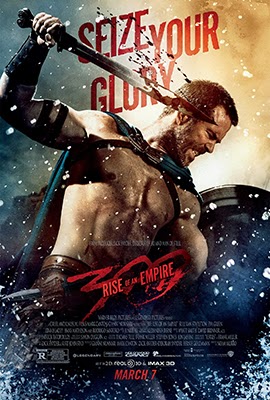
300: RISE OF AN EMPIRE
Reviewed by Patrick Gibbs
GRADE:F
Sullivan Stapelton, Eva Green, Lena Headey, Hans Matheson, Rodrigo Santoro, Callan Mulvey, Jack O'Connel and David Wenham
Screenplay by Zack Snyder and Kurt Johnstad
Directed by Noam Murro
Let's be honest. 300 was not a great film. But it was a good movie.
Director Zack Snyder's adaptation of Frank Miller's graphic novel about the battle of Thermopylale was a triumph of style over substance, with a breathtaking visual style that perfectly captured Miller's comic. It was also the oddest mixture of virulent, ultra right wing ideology and homoeroticism ever put on film.
This mash up between the sword and sandal epic, Robert Roriguez' Sin City and the Joel Schumacher Batman movies was a solid guilty pleasure. The lead performances by Gerard Butler and Lena Headey were campy but sincere, and the movie was dumb fun, and even occasionally veered into moments of genuine emotion. Naturally, a movie that sets the box office on fire the way this did, launches a big career for its director, and was so heavily emulated, is going to spawn a sequel. The problem? The title characters were all killed. All of them. All 300 of them.
Frank Miller went to work on a new graphic novel entitled Xerxes, which was to tell the back story of the movie's villain, the "God King" of Persia. This was a problematic idea, and the book was never published. But this didn't deter the studio, who wanted to press ahead with the film. So Zack Snyder and Kurt Johnstad, the duo that wrote the first film, got to work on adapting it into a workable and coherent script. After seeing the film, I can only conclude that they haven't finished yet.
This movie takes place before, during and after the original film. It's pre-mid-sequel! Themistokles of Athens (Sullivan Stapelton) killed the Perisan king in battle many years ago, but it has haunted him for years that he did not kill the king's son Xerxes (Rodrigo Santoro) instead. Xerxes has since become a force to be reckoned with, and together with Artemisia of Caria (Eva Green), a sexy warrior General with a chip on her shoulder, Xerxes is getting ready to lay waste to all of Greece. Themistokles wishes to unite all of Greece into one empire, but cannot gain support for the idea. Meanwhile, King Leonidas of Sparta heads off with his brave 300 to face Xerxes alone, and Themistokles realizes that this brave but doomed stand against Xerxes may be just the catalyst that he is looking for to rally the people together.
The movie is a disjointed mess that has no sense of flow, and Sullivan Stapelton is quite possibly the blandest leading man to hit the big screen since George Lazenby, or at least Miles O'Keefe. He has no star presence or charisma whatsoever, and barely seems to care about what's going on. The only time he doesn't look bored is during the shockingly graphic sex/fight scene between Temistokles and Artemesia. Eva Green fares better, with a scenery chewing but entertaining performance as the villainess, and she is clearly the main selling point that the studio is latching onto, focusing more on her sex appeal than her acting ability. In fact, perhaps a more apt title for this film would have been 300: A Sale Of Two Titties.
The violence, though stylized and cheesy, is appallingly graphic, with constant geysers of blood and decapitated heads being thrown at the camera in glorious 3D to distract from the lack of story flow and the painfully bad dialogue. some of the naval battle sequences are admittedly spectacular, but by that point in the film you've had to sit through so much exposition and tedium that it's hard to care, and the only character that all of this back story has managed to build up any sympathy for is Artemisa.
The film works neither as entertainment or art, and frankly it ranks well below at least half of the films on my ten worst list for 2013.
300: Rise Of An Empire is rated R for violence, gore, graphic sex, nudity, profanity and vulgarity, and in my opinion should have been an NC17, at least when shown in 3D.
GRADE:FSullivan Stapelton, Eva Green, Lena Headey, Hans Matheson, Rodrigo Santoro, Callan Mulvey, Jack O'Connel and David Wenham
Screenplay by Zack Snyder and Kurt Johnstad
Directed by Noam Murro
Let's be honest. 300 was not a great film. But it was a good movie.
Director Zack Snyder's adaptation of Frank Miller's graphic novel about the battle of Thermopylale was a triumph of style over substance, with a breathtaking visual style that perfectly captured Miller's comic. It was also the oddest mixture of virulent, ultra right wing ideology and homoeroticism ever put on film.
This mash up between the sword and sandal epic, Robert Roriguez' Sin City and the Joel Schumacher Batman movies was a solid guilty pleasure. The lead performances by Gerard Butler and Lena Headey were campy but sincere, and the movie was dumb fun, and even occasionally veered into moments of genuine emotion. Naturally, a movie that sets the box office on fire the way this did, launches a big career for its director, and was so heavily emulated, is going to spawn a sequel. The problem? The title characters were all killed. All of them. All 300 of them.
Frank Miller went to work on a new graphic novel entitled Xerxes, which was to tell the back story of the movie's villain, the "God King" of Persia. This was a problematic idea, and the book was never published. But this didn't deter the studio, who wanted to press ahead with the film. So Zack Snyder and Kurt Johnstad, the duo that wrote the first film, got to work on adapting it into a workable and coherent script. After seeing the film, I can only conclude that they haven't finished yet.
This movie takes place before, during and after the original film. It's pre-mid-sequel! Themistokles of Athens (Sullivan Stapelton) killed the Perisan king in battle many years ago, but it has haunted him for years that he did not kill the king's son Xerxes (Rodrigo Santoro) instead. Xerxes has since become a force to be reckoned with, and together with Artemisia of Caria (Eva Green), a sexy warrior General with a chip on her shoulder, Xerxes is getting ready to lay waste to all of Greece. Themistokles wishes to unite all of Greece into one empire, but cannot gain support for the idea. Meanwhile, King Leonidas of Sparta heads off with his brave 300 to face Xerxes alone, and Themistokles realizes that this brave but doomed stand against Xerxes may be just the catalyst that he is looking for to rally the people together.
The movie is a disjointed mess that has no sense of flow, and Sullivan Stapelton is quite possibly the blandest leading man to hit the big screen since George Lazenby, or at least Miles O'Keefe. He has no star presence or charisma whatsoever, and barely seems to care about what's going on. The only time he doesn't look bored is during the shockingly graphic sex/fight scene between Temistokles and Artemesia. Eva Green fares better, with a scenery chewing but entertaining performance as the villainess, and she is clearly the main selling point that the studio is latching onto, focusing more on her sex appeal than her acting ability. In fact, perhaps a more apt title for this film would have been 300: A Sale Of Two Titties.
The violence, though stylized and cheesy, is appallingly graphic, with constant geysers of blood and decapitated heads being thrown at the camera in glorious 3D to distract from the lack of story flow and the painfully bad dialogue. some of the naval battle sequences are admittedly spectacular, but by that point in the film you've had to sit through so much exposition and tedium that it's hard to care, and the only character that all of this back story has managed to build up any sympathy for is Artemisa.
The film works neither as entertainment or art, and frankly it ranks well below at least half of the films on my ten worst list for 2013.
300: Rise Of An Empire is rated R for violence, gore, graphic sex, nudity, profanity and vulgarity, and in my opinion should have been an NC17, at least when shown in 3D.
Subscribe to:
Posts (Atom)