Friday, December 5, 2014

THE HOMESMAN

Reviewed by Patrick Gibbs

The Homesman poster.jpgGRADE: A
Tommy Lee Jones, Hillary Swank, John Lithgow, Miranda Otto, Grace Gummer, Sonja Richter, James Spader, Tim Blake Nelson, Hailee Stienfeld and Meryl Streep
Screenplay by Tommy Lee Jones and
Kieran Fitzgerald and Wesley Oliver
Based on the novel by Glendon Swarthout
Directed by Tommy Lee Jones

Rated R (violence, sex, rape, profanity, disturbing behavior and brief nudity)

Tommy Lee Jones has been behind the camera before,
with two made for television films and the theatrical feature The Three Burials of Melqeades Estrada to his credit. Jones the director is much like Jones the actor, and Jones the man: surly, boisterous, warm, charismatic and completely infuriating all at the same time.

The story, set in the 1850's, follows Mary Bee Cuddy (Swank), a middle-aged spinster from New York, a former teacher who journeyed to the Midwest for better opportunities. She is an active member of the small farming community she now calls home in Loup City, Nebraska, and has significant financial prospects and sizable land ownership.

After a harsh winter, three young women—Arabella Sours, Theoline Belknapp, and Gro Svendsen—begin to show signs of insanity due to the hardships they have faced. When someone must be chosen for the task of taking these women to a church in Iowa that cares for the mentally ill, Mary Bee volunteers for the task alone because she is unhappy with her life and wants an adventure.

The Homesman  film stillAfter loading the women into a wagon, Cuddy sets out for Iowa, and before she leaves she encounters George Briggs (Jones), a claim jumper, who has been lynched for using another man's land as his own. Sniveling and begging to be saved, Briggs appeals to Cuddy for help. She frees him in return for his help escorting the women, though he only sticks with it because he is getting paid $300.

The Homesman is a riveting film,  unflinching in its portrayal of mental illness and the harshness of life in the period. Some are labeling it a feminist western, and it certainly takes a sympathetic, even loving view of the silent heroines of the times who faced much more dangerous foes than outlaws or Indians, and the fact that they are also prone to the weakness and frailty that comes with being human should not be mistaken for a negative statement: the men in this film are no stronger, and in many cases quite a bit weaker. It's also very likely the only western to ever deal with the subject of clinical depression (though the illness is never named directly) and ultimately the three women are hardly the only mentally unstable characters. In fact, the point of the film, if there is one (and it is surprisingly difficult to tell at times), is that we are all dealing with our own demons, no one is exactly who they seem, and that the best of us (Cuddy) have darkness inside us and the worst (Briggs) are capable of rising to the light if they really want to do so, but we all need help in some form, whether we are quietly pleading for it from whoever there is or are fighting it from those who see something more in us than we do in ourselves. In the end, without someone who cares, all have have is whatever defenses we have built for ourselves.

It is a film that takes quite a bit of of time and thought to digest, and it is so relentlessly bleak and so short on hope that audiences can't really be blamed if they can't get through it.

The performances are excellent all around, and Swank proves once again that she is one of the most daring leading women in film history. Jones can command the screen with the flimsiest of material, and manages to take a character with few if any admirable qualities and pull us toward him, maiking us care far more about him than makes any sense. Otto, Gummer and Richter are mesmerizing as the three women (each is genuinely heartbreaking in their own way), and the rest of the cast is filled with capable actors, including John Lithgow in his second major performance this month (the last being Instersellar.). Between Cliffhanger and 3rd Rock From The Sun, I had grown to think of Lithgow as such an over the top ham that I always get entranced by watching him play a real person.  There are also several extended cameo appearances, which include Jones' fellow Lincoln alumn James Spader and Tim Blake Nelson, Hailee Stienfeld and Meryl Streep (who shares the screen with her real life daughter, Grace Gummer.).  Cameos, especially in a serious film, can be a tricky prospect, and can be distracting and irritating (The Thin Red Line) or subtely effective in creating a feeling that these small characters are real people with their own stories (Saving Private Ryan, Twelve Years A Slave), and thankfully Jones uses these actors very well, giving us the latter. Streep in particular gives a beautifully nuanced performance, providing the film with it's most subtly haunting moment (and I am decidedly not part of the crowd that swoons over every single thing Streep does and thinks she has no peers.).

The cinematography, musical score and editing are expertly done. Jones the director has many admirable qualities, not the least of which is knowing that the camera does not always have to be moving to create a money shot. Jones wears his respect for  the directors that influenced him on his sleeve, whether it is using True Grit's Steinfeld in a cameo or putting a prominent thank you to Steven Spielberg at the end, but if there is one director that Jones channels most, it has to be Clint Eastwood, particularly Unforgiven.

The film does have a slight unfortunate tendency to wander at times,  but it generally finds its way back. Also, like so many other "unflinching" directors, Jones doesn't have the strongest sense of when it's okay to flinch: three scenes in one movie that compete for most graphically unpleasant sex scene of the year is a bit too much for me to be convinced to was essential to the story.

Sill, as a treatise on mental and emotional illness, The Homesman is genuinely brilliant and worthy of recognition.  But if you are going to give this movie a try, be prepared for some very disturbing imagery, including a baby being killed. Don't even try to watch this movie if you are not used to R rated dramas.



Wednesday, November 26, 2014

PENGUINS OF MADAGASCAR

GRADE: B -
Starring Tom McGrath, Chris Miller, Christopher Knights, Conrad Vernon, John Lakovich, Benedict Cumberbatch, Peter Stormare, Annet Mahendru
Reviewed by Paul Gibbs

I've always had a fondness for the Madagascar animated films, while of course recognizing that they weren't up with their Toy Story or the other truly classic animated films of our time. But they're likable and funny, and with more heart than they're given credit for (and a still maintain that first one actually had a surprisingly deep subtext, even if it exists nowhere outside of my own mind). The penguins have always been among the funniest and most popular characters, but they're rather one dimensional comic relief. Could they really carry their own movie? The answer is a qualified yes.

The story begins with an origin of the four penguins (Skipper, Kowalski, Rico and Private) as children in Antarctica (even this actually stretches it a bit with these characters, as detail is not best thing for them, It's not easy for me to accept, even in a cartoon, that they were essentially born thinking they were an elite commando unit). Flash forward to the penguins "escaping" the circus where we saw them at the end of Madagascar: Europe's Most Wanted. Soon the penguins are off on their own for another adventure, one which finds them going up against a dastardly octopus named Dave (delightfully voiced by John Malkovich), and joining voices with an actual elite commando unit called the North Wind, lead by a wolf (voiced by the increasingly omnipresent Benedict Cumberbatch). The character conflict/development is provided by Private's struggle to be a valued member of the team, rather than just being thought of as the cute and cuddly baby brother.


Directors Eric Darnell and Simon J. Smith are working with a script credited to 5 screenwriters who have concocted a plot that's pretty flimsy even by cartoon standards, which is really just a basic framework for non-stop gags, some of which are very funny (the early bits involving nature documentary film crews made me laugh out loud), and some of which fall flat. Even the running gags are inconsistent, as a an endless series of puns involving celebrity names is alternately amusing and tiresome. But the film moves fast enough to avoid wearing out its welcome, and the penguins are endearingly goofy enough to keep us engaged. In particular its surprising that Skipper is actually able to pull of some nice character moments.


DreamWorks Animation has taken a real step forward in sophistication in recent years with films like Rise of the Guardians and the excellent How To Train Your Dragon series. This isn't in the same league. But's going to please its target audience, and there's enough to keep the adults who take them to the theater fairly amused. It's not likely to become a beloved favorite or an Oscar nominee for Best Animate Film, but it's a fun time at the movies showcasing lovably goofy penguins. And did anyone really expect more from it? Besides, any film that manages to cast John Malkovich as an octopus and Peter Stormare as a polar bear gets a pass from me. Don't overthink it or expect too much and you'll have fun.


THE THEORY OF EVERYTHING

GRADE: A+
Starring Eddie Redmayne, Felicity Jones, David Thewliss, Charlie Cox
Screenplay by Andrew McCarten, based on the book by Jane Hawking
Directed by James Marsh
Rated PG-13 (Adult themes, profanity)

It's very understandable if your first instinct upon seeing advertising for The Theory of Everything is that it's the sappiest kind of Oscar bait. Truth be told, between the somewhat syrupy poster and the general vibe I was getting from a lot of directions, I had very little enthusiasm going into this film. It just struck me as the sort of film that exists only to win awards and make people cry at how romantic it is. And being familiar (albeit only vaguely) with the story of Stephen Hawking's marriage, I was worried that this was going to be a whitewashed Hollywood feel-good romance that more or less deified him. Happily, it isn't. Yes, it's blatant Oscar bait. But it's good Oscar bait.


The film begins with Hawking (played by Eddie Redmayne of Les Miserables) as a student at Cambridge in the 1960s. Hawking is a brilliant student who seems to be sort of treading water until he comes up with something truly unique (basically a thin, nerdy British version of Russell Crowe in A Beautiful Mind but with better people skills). He meets and falls in love with the lovely Jane Wilde (Felicity Jones), then is diagnosed with ALS. Since there are no ice buckets to be found, they get married. While Stephen is given only two years to live, he defies that by continuing on despite progressively losing more and more of his motor function, until his confined to a wheelchair and capable of only very slight movement of any kind. Jane remains committed to Stephen throughout his struggles and the births of their children. But there's no denying it's a difficult life for both of them, as Stephen goes on developing the brilliant theories that placed him alongside Albert Einstein in the pantheon of scientific genius. It's here that I should probably mention that those looking for a film about Hawking's theories and his contribution to science and human thought are probably going to be disappointed. While Andrew McCarten's screenplay does an infinitely better job of introducing us to Hawking's theories than A Beautiful Mind did with those of John Forbes Nash, it barely scratches the surface. And it's not even a film about Stephen's bravery or resilience. It's about the relationship between Stephen and Jane.


Redmayne has the showy, Oscary role here, and he's brilliant. Not only does he look like Hawking, his ability to twist and contrort his body to resemble the ravages of the disease is nothing short of astonishing. But even better, he's able to convey a great deal of emotion even after Stephen has lost the power of speech and can barely move anything but his eyelids. It's a performance that easily deserves to be toward the top of the list of Oscar contenders. But Jones brings just as much to the film in a less obvious way, and I'm afraid she'll be overlooked. Jane is the heart and soul of the film, the character we come to love, and without Jones' sublime, sensitive performance, The Theory of Everything would slip into being something akin to The Iron Lady, which is to say a great central performance with nothing surrounding it. Instead, it's a fully realized film, and one which is surprisingly sensitive and fair to both sides of a very complex relationship. Director James Marsh takes a fairly straightforward approach to tell the story, and resists the urge let his directing steal focus from the actors. It's a soft approach, and I find myself once again having to rely on the word "sensitive" to describe it. That's really the word which to me most defines the film.


I found The Theory of Everything to be the kind of film which strikes a very personal chord for me, and I was both very moved and very shaken up by it. It's a beautiful film which I will have to revisit somewhat sparingly as it did provoke a wave of complicated and powerful emotions from me. While some of this was very specific to me, it's hard for me to imagine that many viewers won't find themselves feeling quite a bit because of this movie. If you're prone to crying at movies, you'll cry at this one. But it earns its tears honestly, not through overwrought weepiness or cheap manipulation. It's a very unique love story that may very well be different from what you expect. And in its center are two of the very best performances of the year.


Friday, November 7, 2014

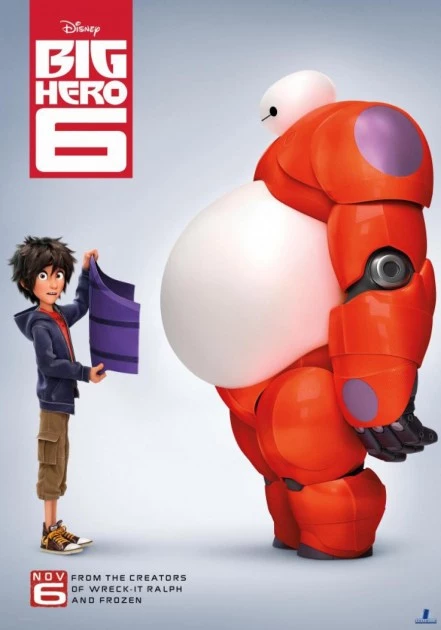
BIG HERO 6

Reviewed by Patrick Gibbs


GRADE: A +
Featuring the voices of Ryan Potter, Scott Adsit, James Cromwell, Jamie Chung, Daniel Henney, T.J. Miller, Genesis Rodriguez, Daman Wayan,s Jr. and Alan Tudyk
Directed by Don Hall and Chris Williams
Rated PG (action and peril, mild rude humor)

Disney Animation studios is on on fire.

The once fledgling afterthought that got started with the meager Chicken Little and stood in the shadow of PIXAR has not only stepped out of that iconic shadow, but after last Wreck It Ralph and Frozen, it's making PIXAR have to work to keep up. The newest offering from the house of mouse is the first genuine Disney movie based on a MARVEL property, Big Hero 6, and it is almost exactl the movie that The Amazing Spider-Man 2 failed to be in ever way.

Set in the fictional Metropolis of "San Fransokyo: (which is just what it sounds like), our story center around a young robotics prodigy named Hiro Hamata. Having graduated High School at 14, Hiro is content to spend his time hustling the rich in underground "Bot Fights," but his older brother Tadashi  (whom you will look at more than once and ask "is that Matt Dillion? But he looks so young" until the person you came to the movie with points out that it's a cartoon, dumbass), wants something better for Hiro. Tadashi is something of an electronics genius himself, and he introduces Hiro to The San Fransokyo Insitute of Technology, a spectacular nerd school run by an icon in the field, Professor Callaghan (voiced by James Cromwell.). Hiro also gets into a new social with Tadashi misfit friends. But most importantly, Tadashi introduces his little brother to Baymax, an inflatable robot built by the elder Hamata brother to serve as a "healthcare companion."
    But when Tadashi .and Callghan are killed in a mysterious explosion, Hiro is on his own. That is, until he accidentally activates Baymax, who sees Hiro as his patient.  Hiro is completely disinterested, until some snooping leads him to believe that there is more to Tadashi's death than meets the eye, and that someone is using an invention of Hiro's to commit evil deeds.

    Hiro programs Baymax to learn Karate, and outfits him with high tech armor, and enlists the aid of his new friends in his quest for truth and justice.

    Visually splendid and full of heart, Big Hero 6 is an utter delight from start to finish. Baymax (voiced by Scott Adsit of 30 Rock fame) is one of the most endearing characters to hit the big screen in years, and the relationship between the boy and the bot is charming, fun and touching.  The movie is packed with action but very low on violence, and the sense of humor is much more sophisticated than the trailers indicate (looking back at the trailers for The Incredibles, Disney has a knack for dumbing down it's advertising.). As much as it should feel tired and annoying for this story to turn into yet another superhero adventure when Hollywood is so overpacked with them, it is such a good one (and a unique one) that it's cause for celebration rather than eye rolling.

    Big Hero 6 is that proverbial "fun for the whole family" movie that will leave laughing, crying, blah blah blah yadda yadda yadda. You get the idea, but I'm telling you, it really is that good.

    The movie is suitable for most ages, but does feature enough intensity and strong emotion that it maybe not be right for some kids 4 and under (you know your kid better than I do, hopefully: you be the judge.).


    Wednesday, November 5, 2014

    INTERSTELLAR


     Reviewed by Paul and Patrick Gibbs


    GRADE: A 
    Matthew McConaghey, Anne Hathaway, Jessica Chastain, MacKenzie Foy, Wes Bentley, Michael Caine Written by Jonathan Nolan and Christopher Nolan
    Directed by Christopher Nolan
    Rated PG-13 (Violence, profanity, intensity)


    Sometime it's hard to know whether to rate a film based on its ambitions, or how well it achieves them. Interstellar is one of the most ambitious films to come out of Hollywood this decade, a mix of cerebral sci-fi and commercial blockbuster that wants to engage the intellect and emotions equally. Even from the brilliant director Christopher Nolan (Inception, the Dark Knight trilogy) it's not a surprise that it's not 100% successful at achieving these goals. But it does manage to be a dazzling, awe-inspiring cinematic experience with some actual science (thanks to consultant Kip Thorne), and it's also dramatically moving (thanks in large part to leading man Matthew McConaughey, whose career resurgence now includes showing he can carry an epic).

    McConaughey stars as Cooper, an engineer who trained as an astronaut but was forced to become a farmer when an environmental disaster called "The blight" turned Earth into a dust bowl that could barely grow anything, leaving humankind on the verge of extinction.  Cooper has a close bond with his children, especially his 10 year old daughter Murph (Mackenzie Foy). When a wormhole is discovered near Saturn, Cooper is chosen to fly a mission through it to save the human race by finding inhabitable extra solar planets in another galaxy. But this means leaving his children, possibly to never return (or to return to discover that the effects of relativity have made his children older than him. The scenes of Cooper leaving his children and the emotional effect it has provide the film with its human drama, and McConaughey and Foy (and later Jessica Chastain as adult Murph) nail the emotional content of the film.

    Cooper is joined on the mission most prominently by Dr. Amelia Brand (Anne Hathaway), a brilliant scientist, and a really cool robot named TARS (who resembles the iconic monolith from Stanley Kubrick's 2001). The voyage of their ship, Endurance, takes them on an epic journey across space and time.

    Nolan is a superb storyteller, and he achieves several moments of brilliance here, and an overall very good
    film. But there's simply no way to completely tie everything he's trying to do here into quite the satisfying whole his biggest successes have been. The mix of science and sentiment, along with just some existential speculation, is somewhat tenuous and threatens to break apart at times. The third act is particularly likely to be divisive, as we're unsure whether he's trying to go for Kubrickian brainy sci-fi philosophy, Spielbergian sentiment (the film was actually originally developed as a project for Spielberg) or just "whoa, dude" head trip fare. The film never jumps completely off the rails, but it flirts with it at times, and also sometimes gets a little hard to follow (as good as it is, Hans Zimmer's booming musical score and the fact that Nolan has mixed it too loud don't help).

    But through the whole thing, McCounaugey's excellent leading man turn and Nolan's formidable skills as a director manage to steer through the pitfalls of the perhaps overly ambitious material to pull us in. The supporting cast is strong, though Hathaway's character is underdeveloped and we never get a complete handle on her. TARS manages to steal the film with a likable personality and unique design. The film is visually resplendent, including a large number of sequences shot in IMAX (it's definitely worth the extra expense to see it in the large-screen format).  The space sequences are absolutely eye-popping.

    Ultimately, Interstellar isn't perfect, and it's going to be a love it or hate thing for a lot of people. For us, it's a worthy addition to Nolan's filmography that deserves admiration for aiming so high, even if it can't quite nail its target.

    Thursday, October 23, 2014

    ST. VINCENT

    Reviewed By Patrick Gibbs


    GRADE:  B+
    Bill Murray, Melissa McCarthy, Naomi Watts, Jaden Leiberher, Chris O'Dowd, Terrence Howard, Scott Adsit, Dario Barasso
    Written and directed by Theodore Melfi
    Rated PG-13 (for mature thematic material including sexual content, alcohol and tobacco use, and profanity)

    If there is one person in Hollywood who wants an Oscar even more desperately than Leo DiCaprio, it's Bill Murray. He's been fishing for one since The Razor's Edge back in 1984, and he finally came somewhat within reach with his nomination for Lost In Translation (although everyone knew that he would never beat Sean Penn, with the exception of Murray himself, who was caught looking less than gracious in defeat on camera.). While I delight in every performance he gives in a Wes Anderson film, and still think he deserved a nomination for Groundhog Day, I confess that I find the Oscar grubbing tedious, and I have a lot of trouble getting up enthusiasm for his yearly bid (having missed the press screening, I still have not worked up enough interest to see Hyde Park On Hudson, even though FDR is one of my personal heroes.). That being said, he does indeed deserve a recognition for his multi-layered and beautifully nuanced performance in St. Vincent, and it's very easy to get behind him on this one because the movie is more than just a showcase for Murray the serious actor. While he is the lead, he shares the spotlight with young newcomer Jaiden Leiberher, and the film is a strong ensemble piece.

    Vincent (Murray) is a drunken, gambling, misanthropic war veteran who lives alone in his house, with his only company being the occasional paid visit from Daka (Naomi Watts), a Holllywood Russian prostitute and stripper who's career is in a bit of slump thanks to an increasingly noticeable baby bump.  But Vincent's life of intentional isolation is interrupted when new neighbors move in next door.  Maggie (Melissa McCarthy), a very recently divorced single mother, and her pre-teen son Oliver (Leiberher.).


    They get off on the wrong foot when the moving van damages Vincent's fence and tree, but when Oliver is bullied at the Catholic school he attends and his wallet and keys are stolen, he has no choice but to ask the neighbor if he can use his phone to call his mother. Oliver ends up staying with Vincent until Maggie's shift at the hospital ends, and when she arrives to pick her son up, she is met with a surprising proposition: Vincent will look after the boy every day after school, for $12 an hour. Having nowhere else to turn for babysitting, and talked into it by Oliver himself, who is badly in need of a friend and finds Vincent strangely interesting, she accepts.

    Oliver and Vincent become an unlikely dynamic duo, as Vincent takes the kid along with him to the race track, to bars, and to a nursing home where he regularly visits one of the patients. He even coaches the boy in self defense. Maggie is so overwhelmed at work that she doesn't pry into their activities. Meanwhile, at school, Oliver is learning about the saints, and is given the assignment to observe someone in real life and determine if they possess the qualities for sainthood.


    Nothing about the premise here is exactly cutting edge, and elements of it feel a litle bit forced, but the sincerity of the performances and the witty, understated screenplay make it thoroughly enjoyable. The chemistry between Murray and Lieberher is nothing short of perfection, and every time they are on screen together the movie soars, even in the simplest of moments. 


    st-vincent-movie-photo-3
    If there is one thing that generally gets me even less than excited than a Murray Oscar bait flick, it's a Melissa McCarthy comedy. It's not that I don't recognize her talent, but I don't find the crass slob character doing all of the fat jokes and the bathroom humor funny when it's a man, so the hilarious twist of making a woman be the boisterous fool is lost on me. That being said, McCarthy really shines as Maggie, breaking away from typecasting a bit to play a complex character that is equal parts loving, devoted mother and self pitying, angry divorcee (she does get to cut loose in one particularly hilarious scene, but it's still very low key compared to what we've come to expect.) You genuinely grow to to love this trio as if they are real people, because they feel so real. By far the most outlandish abd silly character is Daka, and the only reason she manages to work is because Naomi Watts is such an outstanding actress that she managed to bring some level of truth to performance in Movie 43.  Still, the character is intrusive and a bit out of step, and one can't help but wonder if writer-director Theodore Melfi had a chance to work with Watts and grafted her into the script at the last minute.

    St. Vincent is a feel good movie that is just dark enough to appease the more jaded moviegoer, and touching enough to win over those who find Murray's hedonistic antics initially off-putting. It may not be a gut buster, but its genuine laugh out loud moments are duly earned. This is definitely not a family movie, per se, but if you are an adult looking to for a movie to take your mother to see, you'll  likely both leave happy that you chose St. Vincent, which truly does posses all the qualities needed for a solid and moving piece of entertainment. 


    The only level on which the film completely fails is as a showcase for the increasingly declining Terrence Howard, who is wasted in a small and thankless role (and Marvel geek in me couldn't help but find it amusing that the film was executive produced by his Iron Man replacement, Don Cheadle, which is almost certainly as irrelevant as the fact that Moon was directed by David Bowie's son and produced by Sting's wife, but I notice these things.).


    Friday, October 17, 2014

    FURY

    Reviewed by Patrick Gibbs


    GRADE:  A-

    Brad Pitt, Shia LaBeouf, Logan Lerman, Michael Pena, Jon Bertnthal, Jason Isaacs, Scott Eastwood 
    Written and directed by David Ayer
    Rated R (Violence, gore, profanity, sexuality, vulgarity, smoking, and Shia LeBeof with a mustache)


    In the 1998 comedy Small Soldiers, Phil Hartman is watching an old war movie on TV and wistfully remarks "I think World war II was my favorite war." 

    This has long been true of Hollywood and the average moviegoer/history buff. One of the reasons for this may be that it was the last major American war with a clear objective that we can all (at least to some extent) understand, and it easily has the best villain. Even those of us who are anti-war and anti-military can appreciate the need to stop Hitler from conquering the world. But there is still too much romanticism and hero worship attached to the war for my comfort. I'm not saying that that the soldiers who fought in Europe weren't heroes on a very real level: their sacrifice is immeasurable and they may very well have saved the world. But how do you fight a war without destroying yourself? How do you get right in the the thick of the most insane and appalling of enterprises, blowing people up left and right, and manage to stay alive inside, even if you manage to stay so on the outside? David Ayer's new film argues that maybe you don't. Maybe you can't. You have to kill yourself before you can kill others.

    Fury is set during the last few months of the European Theater of War in April, 1945. As the allies make their final push into Nazi Germany, a battle hardened U.S. Army Sergeant named Collier (Brad Pitt) in the 2nd Armored Division commands an M4A3E8 Sherman Tank nicknamed "Fury," and the five men who serve aboard it. One of these men has just been killed, and a last minute replacement gunner is needed. Enter Norman (Logan Lerman), a clerk typist who hasn't seen any action, who somehow gets assigned to this post. Norman is a scared, mild mannered and very moral young man who could not possibly fit in less with his comrades, who are all seasoned killers, and not the most pleasant of people. In fact, at times they seem downright evil, and Norman just might be more terrified of them than he is of the Nazis.

    The two obvious and inescapable comparisons here are Saving Private Ryan, in particular the character of Corporal Upham (portrayed by Jeremy Davies), and Training Day, the police drama that won Denzel Washington an Oscar and brought writer David Ayer to prominence in the first place. In many ways,  this is Training Day goes to war, as we follow the baptism by fire of a naive young man who is being trained by the toughest of the tough and having his squeamishness and ideas about morality beaten out of him in the process. The arrogant machismo practically drips off of these guys, and ostensibly, they are trying to "make a man out of Norman," but in reality they are taking that away from him. They make him clean the gruesome remains of the man he is replacing out of he tank; they force him to kill, and even talk him into taking a young German girl to bed during a brief moment of R&R. This interlude is extremely uncomfortable but riveting, as we try to figure out if this is a shared moment of happiness between two strangers or a peer pressure rape.

    What makes the movie work is the realization that we do indeed see moments of humanity in all of these guys. In one of the film's most memorable dialogue scenes, Jon Bernthal, as the toughest member of the group, apologizes to Norman for the way he's treated him "You're a good man, Norman," he says. "I think maybe we're not, but you are."

    No one one in this film is black and white good or bad. They are so far removed from the people that they used to be, in a place where doing the right thing is so contrary to their mission that they are really all just becoming machines. We see a lot of atrocities committed: imagine if the "Look: I washed for supper!" guys in Saving Private Ryan were the main characters. This may be the least flattering portrayal of American soldiers in Hollywood since Casualties of War, but it stops short of completely judging them. The war itself is the monster.

    The tank battle scenes are pulse pounding, and the level of violence and destruction is truly grotesque, at Saving Private Ryan or Black Hawk Down levels but treated more casually. Especially in its final section, Fury almost falls into the horror genre, which is a surprisingly effective choice.

    It's very hard to make a war movie, especially a WWII movie, that doesn't recycle cliches and formulas (even Private Ryan abounded in them), and there is definitely a strong "I've seen this before element" to the film. But as both writer and extremely skilled director, Ayer tries hard to balance that with just enough "I've never seen that before" to keep you feeling both satisfied and completely assaulted at the same time.

    The acting is strong all around, with Lerman as the clear standout, but Bernthal is an incredibly strong presence, and we are reminded that all of the hype, backlash and self destruction put aside, LeBeouf really can act. Of course the movie is selling itself on the strength of Brad Pitt, who delivers an enigmatic but engaging performance, and of course gets the requisite scene where he takes his shirt off to show us a physique that makes you wonder how he manages to fit all of the Nautilus equipment inside a Sherman, and also show the obligatory scars burns all over his back that make us realize that this man has been through hell and back, and we can't judge him until we've walked a mile in his combat boots and that we should never judge a book by its haircut. What makes this over the top and cliched character work is the choice not to play it as a scenery chewing role but with a detached sense of melancholy.

    Fury is a  little bit longer than it really needs to be, and it is definitely not for all tastes, and especially not for those easily bothered by blood and gore. It has its moments of over the top, "damn the torpedoes" heroics, but there is a feeling of misguided futility to it all.  I'm not against supporting the troops by any means, but after more than a decade of unquestioned flag waving and country music propaganda songs, I really liked seeing a film that does for the American G.I. what Unforgiven did for the wild west gunfighter, and dares to say that if war is hell, at some point you're going to find yourself embracing the devil.